Will AI Replace Civil Engineers in 2026? What Changes, What Stays Human
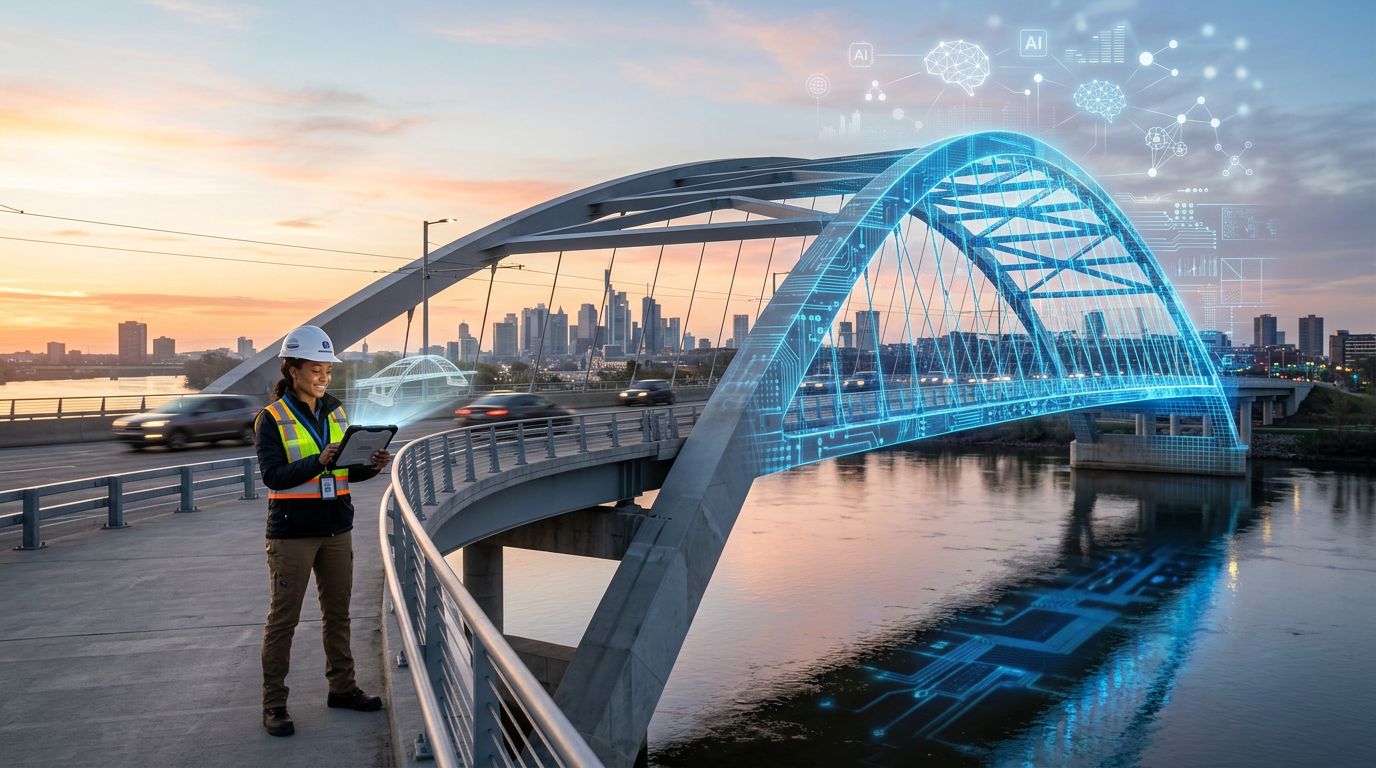
A bridge doesn’t care if your plan set was drafted by a person or suggested by a model. It only “cares” about physics, load paths, and construction quality.
That’s why the real question isn’t whether AI will replace civil engineers. It’s whether AI will replace parts of civil engineering work, and whether civil engineers will still carry the legal and ethical responsibility when something goes wrong.
In 2026, ai civil engineering looks less like robot engineers and more like faster analysis, better inspection, and fewer hours lost to paperwork. The winners will be the engineers who can supervise AI output, catch errors, and document decisions.
What AI is already doing well in civil engineering (and what it can’t do)
AI shines when the work is repetitive, pattern-based, or data-heavy. That includes using computer vision for defect detection, comparing progress photos to a schedule, or searching years of inspection notes for risk signals. Many firms are also experimenting with AI-assisted design options and planning support, especially when paired with building information modeling and digital twins.
ASCE has highlighted practical “AI-integrated systems” that help construction teams spot issues earlier and reduce rework, without removing engineers from the loop (for example, AI for structural health monitoring, site monitoring, inspection support, and decision assistance). See ASCE’s roundup of AI-integrated systems in construction.
On the other hand, AI struggles with what civil engineers get paid to do:
- Interpret messy context (politics, utilities, site constraints, public safety).
- Make tradeoffs under uncertain data.
- Defend decisions under standards of care.
- Take responsibility under licensure.
Even a strong machine learning model can confidently produce wrong answers. That matters because civil engineering is a licensed profession. Most jurisdictions still require a human PE to be in responsible charge and to seal final documents. AI can assist the work, but it can’t “own” the outcome in any meaningful legal sense.
AI can speed up engineering, but it doesn’t absorb liability. The person and the firm still do.
There’s also a cost side people ignore. More AI means more data handling, more storage, and more cybersecurity work. ASCE’s discussion on the topic is blunt about benefits and pitfalls, including reliability and energy use. A good starting point is how civil engineers can strike the AI balance.
Automation risk in civil engineering tasks (where humans stay in the loop)
Not every task faces the same level of change. Here’s a practical map you can use for career planning and staffing.
| Civil engineering task | Automation risk | Human-in-the-loop need (why it still matters) |
|---|---|---|
| Drafting plan sheets, labeling, basic annotations | High | Engineer reviews, checks standards, coordinates with discipline leads |
| Quantity takeoffs and early cost estimates | Medium | Validate assumptions, reconcile scope gaps, document basis of estimate |
| Preliminary alignment/layout options in transportation planning (roads, utilities) | Medium | Confirm design criteria, right-of-way limits, constructability |
| Stormwater management screening and scenario comparisons | Medium | Select methods, validate inputs, check edge cases and local guidance |
| Structural analysis runs and load combinations setup | Medium | Ensure modeling intent, apply code judgment, review sensitivity |
| Construction progress tracking from photos/video | High | Verify mismatches are real, handle obstructions, tie to pay items |
| Safety risk flagging from incident data | Medium | Confirm causality, avoid bias, turn flags into field actions |
| Clash detection and model coordination | High | Resolve conflicts with tradeoffs, sequence, and contract constraints |
| Permitting narratives and report drafting | High | Engineer ensures technical accuracy and regulatory fit |
| Final design sign-off, sealing, and “responsible charge” | Low | Non-delegable duty, professional judgment, legal accountability |
The pattern is simple. AI pushes hardest into workflow automation for production work and first-pass analysis, driving operational efficiency. Meanwhile, engineers keep control of assumptions, exceptions, and final calls.
Research also backs up this “task shift” view. A 2025 peer-reviewed overview in Frontiers describes how AI use in civil engineering, including design automation, is expanding across design, construction, and asset management, while also raising issues around data quality and governance (both require human control). See emerging AI applications in civil engineering.
How to future-proof your civil engineering career with AI (without becoming a software engineer)
Future-proofing your civil engineering career with AI is a key part of professional development. You don’t need to pivot into machine learning to stay valuable. You do need to become the person who ensures human involvement while using AI responsibly and catching what it misses.
Start with skills that map to daily work:
1) Get strong at data literacy (it’s the new field notebook)
Learn how project data is structured, stored, and audited through data analysis. That means spreadsheets, databases basics, geospatial data in GIS layers, and model metadata. If you can’t trace inputs, you can’t defend outputs.
2) Build a small “AI-assisted” portfolio that looks like real practice
One good project beats ten vague ones. For example:
- A drainage concept study where large language models help draft alternatives or reports, but you provide hand checks and assumptions.
- A construction photo log classifier that flags likely nonconformance, plus a clear false-positive review step.
- A simple risk dashboard for assets using inspection history, with documented thresholds and limits.
3) Treat QA/QC as your career moat
As AI speeds up production to provide real-time insights, review skill becomes more valuable, not less. Tighten your habits:
- Keep a written “basis of design” and assumption list.
- Run independent checks (hand calc spot checks, alternate methods, sanity bounds).
- Save model versions and prompt history when AI supports deliverables.
- Log what you accepted, what you rejected, and why.
4) Learn the tools your firm actually touches
Focus on the workflows near your role: CAD/BIM, scheduling, inspection, and reporting. Many AI wins come from connecting systems (models, schedules, RFIs, photos) so teams don’t hunt for info.
5) Know where licensure draws a hard line
If you’re on a PE track, practice “responsible charge” thinking now. Would you be comfortable explaining this AI-supported choice to a reviewer, a client, or a board? If not, the workflow isn’t ready yet.
One more angle: safety. AI can help spot patterns in incidents, but human involvement is essential to validate results and avoid over-trusting correlations. A 2025 study in Scientific Reports reviews machine learning approaches for construction safety prediction, which is useful context for what models can and can’t infer from messy jobsite data. See machine learning for predicting safety incidents.
For AEC leaders: where AI implementations go wrong (and how to avoid it)
AI adoption in project management and construction management often fails for boring reasons. The model isn’t the main problem. The process is.
ASCE has reported growing interest in AI across infrastructure, alongside serious questions about risk and return, governance, and readiness. That tension shows up clearly in AI adoption risks and returns in infrastructure.
Here are common pitfalls to plan for:
- Governance gaps: Teams use AI without an approved workflow, review standard, recordkeeping rule, or consideration of ethical implications.
- Model risk and documentation: Nobody can explain inputs, training limits, or why a recommendation changed from last month.
- Cybersecurity and client data: Uploading drawings or site photos into the wrong system can create contract and security issues.
- Change management: Civil engineers and other staff resist AI when leaders sell it as a headcount reducer. Adoption improves when it’s framed as reducing rework and burnout, particularly for high-value use cases like budget intelligence and predictive maintenance.
- False confidence: Polished text and neat charts can hide bad assumptions, so reviewers need time and authority to push back.
If AI output can’t be traced, checked, and documented, it doesn’t belong in a deliverable.
Conclusion: AI won’t replace civil engineers, but it will replace “unreviewed” work
In 2026, ai civil engineering, with technologies like generative design, automated feature extraction, and processing of geotech reports advancing rapidly, is mostly about task automation and better decision support, not replacing licensed responsibility. These tools cannot replace the final signature, though routine work will shrink, while judgment, review, and communication will matter more.
If you’re a civil engineer, invest in data literacy, QA/QC muscle, and documentation habits now. Then ask a simple question on every AI-assisted task: can you explain it, defend it, and sign your name to it with confidence? That’s where human engineers stay essential, as civil engineers keep the human element at the core of the industry.