Over the last decade reviewing software, I’ve seen text-to-speech (TTS) technology evolve from clunky, robotic narrators into something genuinely impressive. The days of cringing at a computerized voice are largely behind us. Today, the best text to speech software can produce voices so natural and emotionally resonant that they’re often indistinguishable from human narration. I’ve spent countless hours testing these platforms for everything from personal projects to professional voice-over work, and the quality gap between the top contenders and the rest is massive.
Finding the right tool, however, is a huge challenge. Are you a podcaster needing a lifelike co-host voice? A developer integrating voice features into an app? Or maybe a content creator looking to turn blog posts into engaging audio? Each use case demands different features, from hyper-realistic voice cloning and emotional inflection control to simple, one-click API integrations. The pricing models are just as varied, ranging from free tiers perfect for small tasks to enterprise-level plans for high-volume production.
This guide is the culmination of my hands-on testing. I’ve waded through the marketing jargon to give you a clear, no-fluff breakdown of the top TTS solutions available today. We'll dive deep into what makes each platform stand out, exploring its unique strengths, potential drawbacks, and ideal user.
Here’s what you’ll find for each tool we cover:
- A quick, honest review based on my direct experience.
- Practical use cases to help you match the software to your project.
- Clear pricing details so you know exactly what to expect.
- Direct links and screenshots to see the platforms in action.
My goal is to help you cut through the noise and confidently choose the perfect text-to-speech software for your specific needs and budget. Let’s get started.
1. ElevenLabs
When it comes to raw, lifelike vocal quality, ElevenLabs has consistently set the benchmark in my testing. After reviewing dozens of platforms over the years, the nuance and emotional range their AI voices deliver is genuinely a cut above the rest, making it my top pick for the best text to speech software available today. It’s not just about clarity; it’s about inflection, pacing, and the subtle imperfections that make a voice sound truly human. For creators needing premium audio for narration, podcasts, or video, the output quality here is often indistinguishable from a professional voice actor.
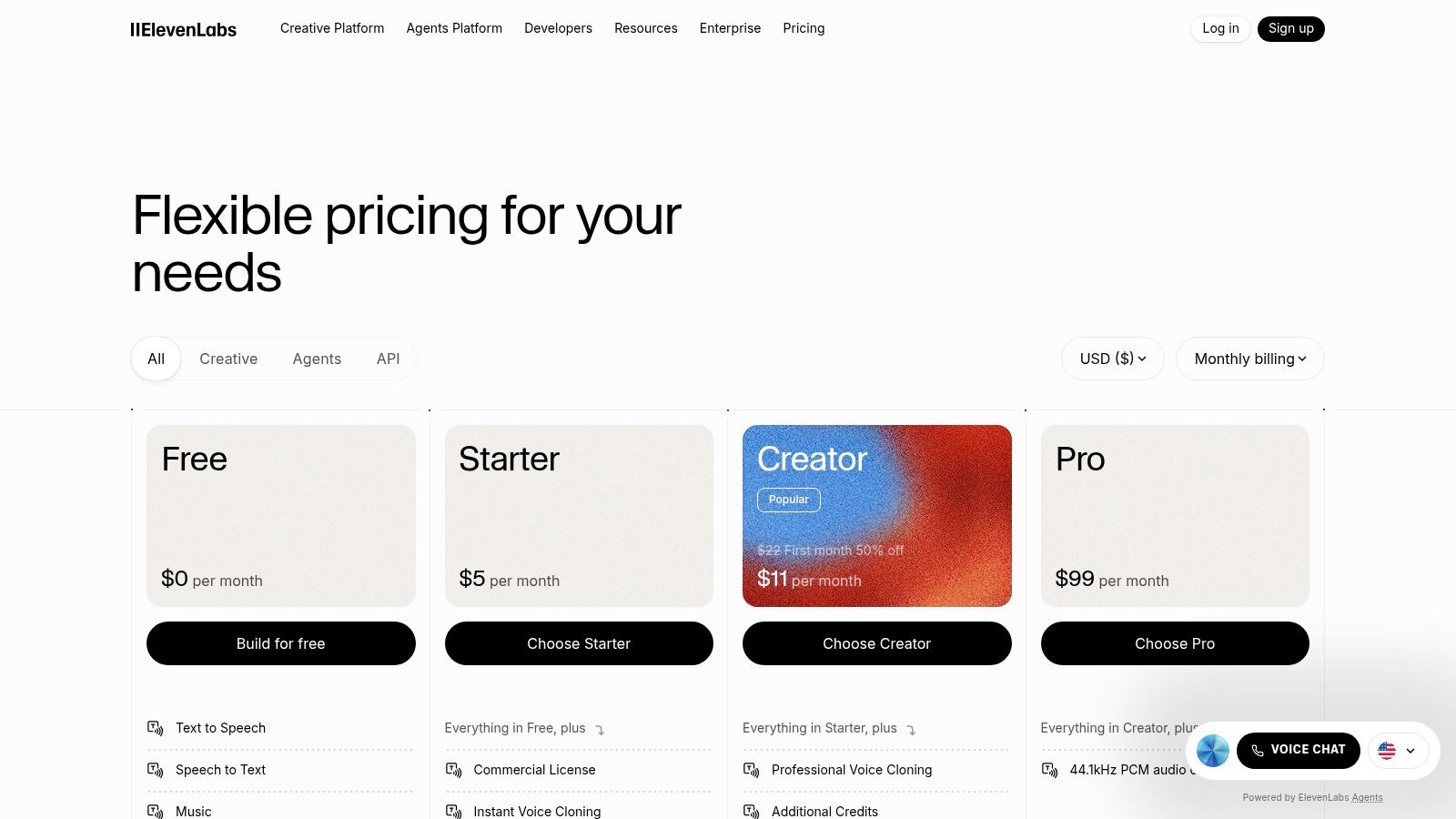
The platform isn't just a simple text-to-voice converter. It’s a full-fledged audio production suite. Their Speech Synthesis studio allows you to fine-tune stability, clarity, and style exaggeration for precise control. This level of customization is invaluable for projects that demand a specific tone. For instance, I've used it to create audio versions of articles, a process you can explore in more detail with our guide on how to convert blog articles into podcast episodes using AI.
Key Features and My Take
- Voice Quality: Unmatched realism with a vast library of pre-made voices. The higher-tier 192 kbps audio option is fantastic for professional projects.
- Voice Cloning: The Instant Voice Cloning feature is surprisingly effective from just a minute of audio, though their Professional Cloning offers impeccable, high-fidelity replication.
- Pricing Model: It uses a credits-based system, which is flexible but requires you to estimate your usage. The free tier is generous enough (10,000 characters/month) to get a real feel for the platform, but a commercial license requires a paid plan.
Visit Website: https://elevenlabs.io
2. Amazon Polly (AWS)
For developers and businesses needing a robust, scalable, and reliable engine, Amazon Polly is my go-to recommendation. While it lacks the polished, creator-focused interface of others, its power lies in its backend integration within the AWS ecosystem. I've implemented Polly in various application prototypes over the years, and its predictability and performance are unmatched for large-scale workloads like powering an app's accessibility features or generating audio for an entire e-learning platform. It's less a studio and more a powerful utility, making it a different kind of best text to speech software.
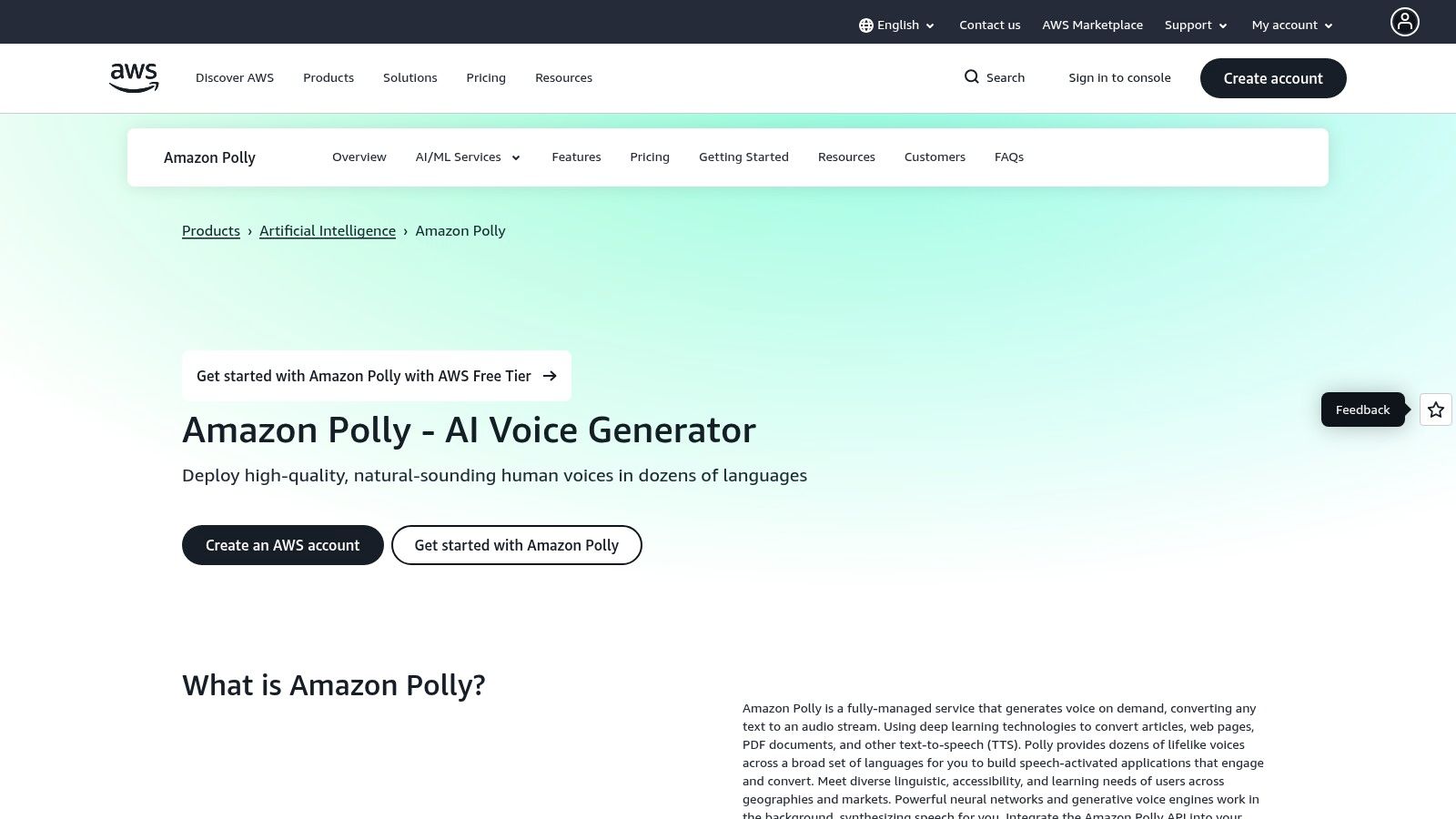
Polly shines in automation and programmatic use. Using their SDKs, you can generate audio on the fly with just a few lines of code, a process I've found incredibly efficient for dynamic content. The platform offers a range of voice types, including standard, the more natural-sounding Neural voices, and even a newer Generative engine for highly expressive speech. This flexibility allows you to balance cost and quality depending on the project's requirements, from simple IVR systems to sophisticated narration.
Key Features and My Take
- Engine Variety: Access to Standard, Neural, Long-Form, and Generative voice engines provides excellent flexibility for different use cases and budgets. The Neural voices are solid and dependable.
- Scalability & Reliability: Built on AWS infrastructure, it offers enterprise-grade uptime and can handle virtually any volume of requests, which is crucial for production applications.
- Pricing Model: Its pay-as-you-go, per-character model offers granular cost control, which is great for developers. However, the console UX is utilitarian and feels more like a developer tool than a creative suite.
Visit Website: https://aws.amazon.com/polly/
3. Google Cloud Text-to-Speech
For developers or businesses who need robust, scalable, and highly customizable voice synthesis integrated directly into their applications, Google Cloud's Text-to-Speech platform is an engineering powerhouse. Over the years, I've seen it evolve from its impressive WaveNet models to the latest Gemini-TTS. What stands out to me isn't a flashy user interface, but the sheer technical depth and the granular control it offers. This is the best text to speech software for projects that require deep integration, stability, and access to Google's cutting-edge AI research. It’s less of a simple tool and more of a foundational building block for creating voice-enabled products.
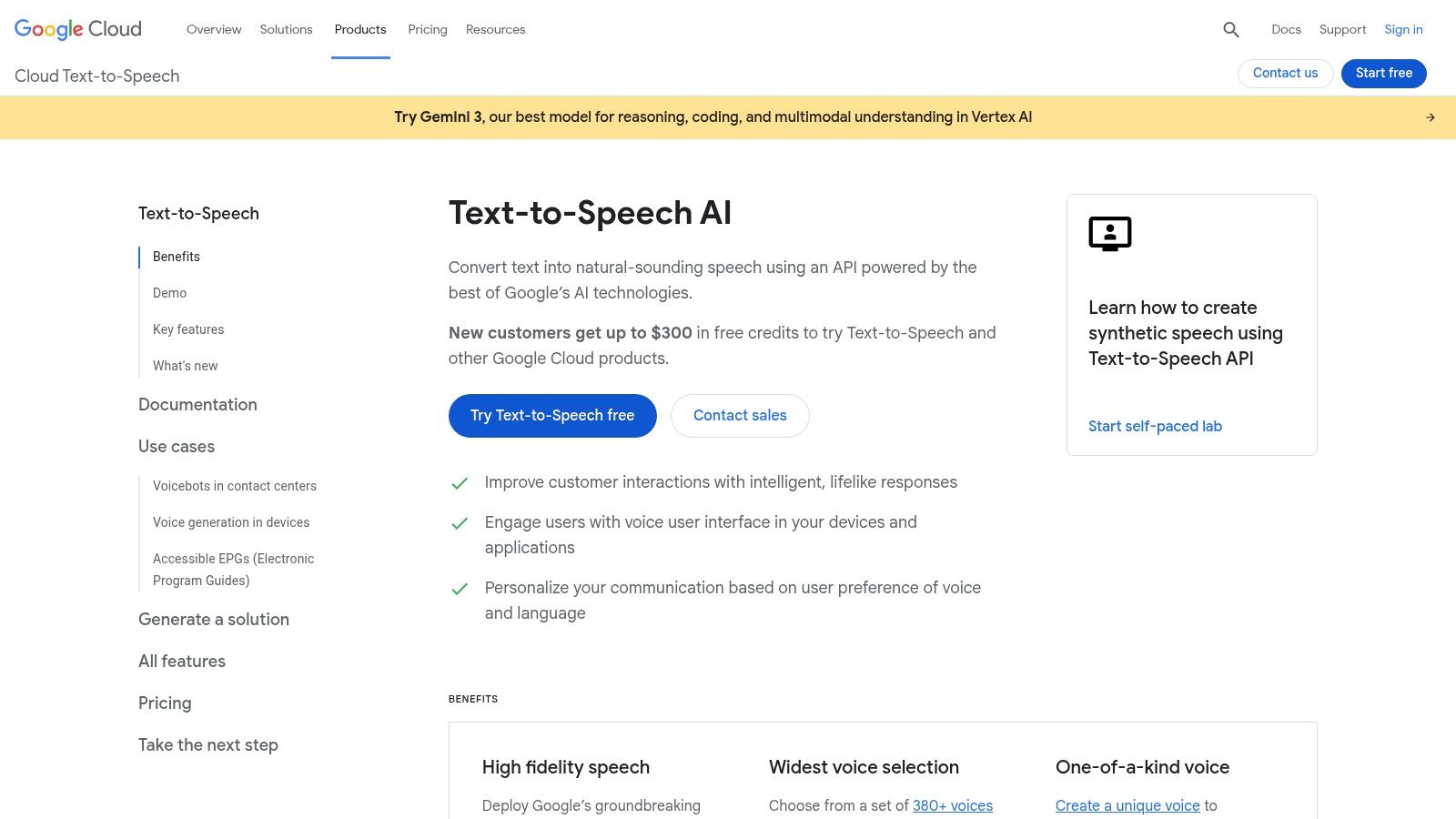
The platform is managed through the Google Cloud console, which can feel intimidating for beginners but is a familiar environment for developers. It offers tiered model families, from the cost-effective Neural2 to the high-fidelity Chirp 3 HD and Gemini-TTS, allowing you to balance quality against cost for different use cases. Full support for Speech Synthesis Markup Language (SSML) means you can precisely control pronunciation, pitch, and pacing directly within your text input, a critical feature for professional narration or interactive voice response (IVR) systems.
Key Features and My Take
- Tiered Model Lineup: The choice between models like Gemini-TTS, Chirp 3 HD, and WaveNet is a huge plus. You can select the right voice technology for your budget and quality needs, from basic notifications to premium audiobook narration.
- Developer-First Approach: It's built for integration via API. If you're building an application, its reliability and scalability are top-tier, leveraging the same infrastructure that powers Google's own products.
- Pricing Model: The pay-as-you-go pricing per character (or token for newer models) is incredibly transparent and cost-effective at scale. However, the model complexity and the new token-based pricing can be a learning curve compared to simpler, all-in-one tools.
Visit Website: https://cloud.google.com/text-to-speech
4. Microsoft Azure AI Speech (Text to Speech)
For organizations already embedded in the Microsoft ecosystem, Azure AI Speech presents a compelling, enterprise-grade solution. In my experience testing platforms for large-scale deployment, Azure stands out for its robust infrastructure, security, and tight integration with other Azure services. While it may not have the same plug-and-play simplicity as some consumer-focused tools, it offers unparalleled control and scalability for developers and businesses building voice-enabled applications. It’s the kind of powerful, reliable engine you build on top of, not just a simple converter.
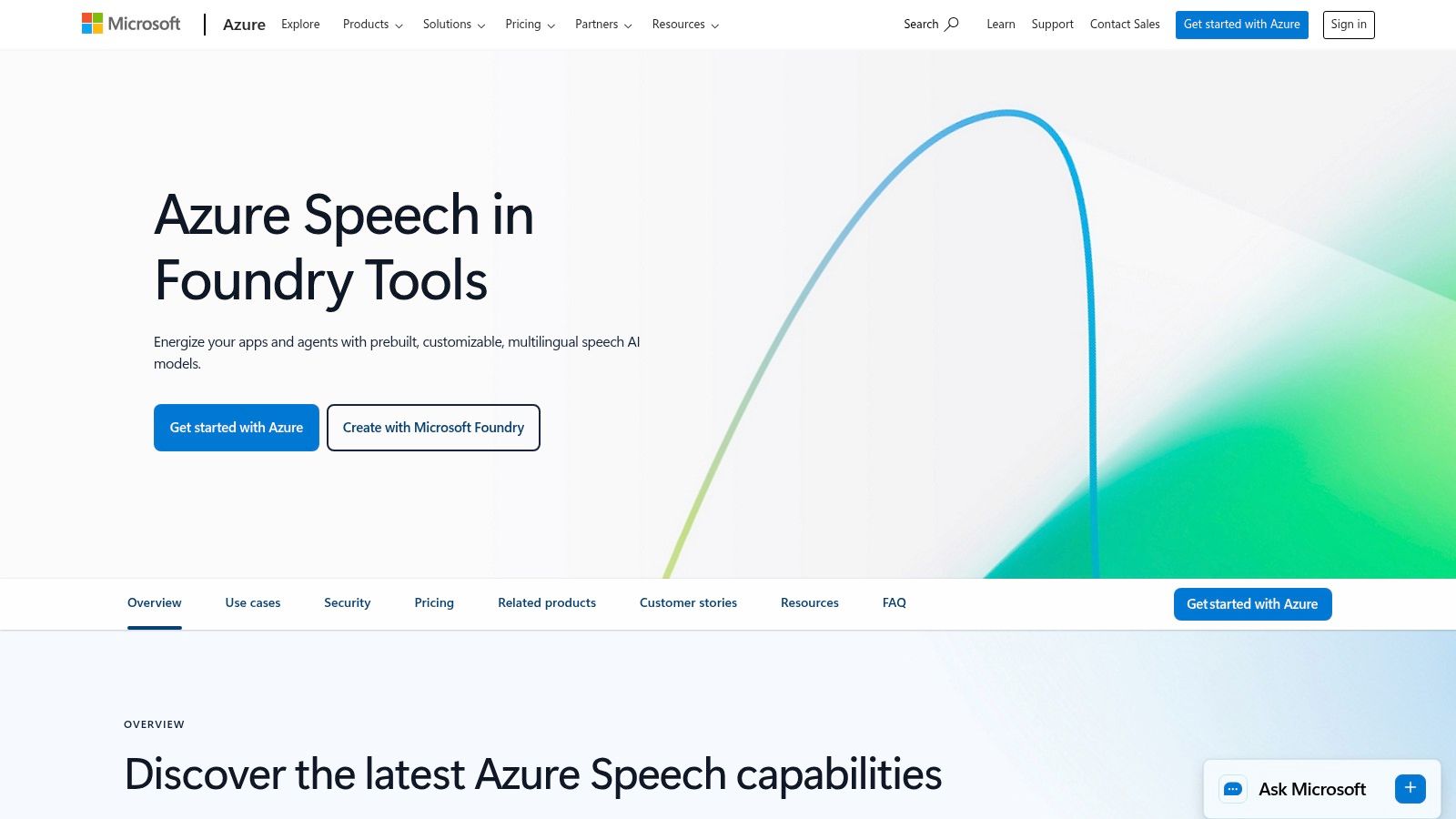
What I find most impressive is its deployment flexibility. You can leverage its TTS capabilities in the cloud via real-time or batch synthesis, but you can also deploy the service in containers. This is a game-changer for applications that need to run in disconnected environments or have strict data governance requirements, allowing processing to happen on-premises. This level of control makes it a standout option in the best text to speech software category for corporate and high-security use cases.
Key Features and My Take
- Integration: Its biggest strength is its seamless fit within the Azure cloud platform. If your tech stack is already built on Azure, integrating AI Speech is a natural and efficient choice.
- Deployment Flexibility: The ability to deploy via containers (both connected and disconnected) offers a level of control and privacy that most cloud-only competitors cannot match.
- Pricing Complexity: The pricing model is its main hurdle. It’s built for enterprise consumption with pay-as-you-go and commitment tiers, which can be confusing to parse for smaller projects. Getting a precise cost estimate requires a careful reading of their documentation.
Visit Website: https://azure.microsoft.com/en-us/products/ai-services/ai-speech
5. IBM Cloud Text to Speech
When the conversation shifts from creative projects to enterprise-grade, regulated environments, IBM’s offering immediately comes to mind. Throughout my years of testing, I've seen many platforms excel at creative tasks, but IBM Cloud Text to Speech is built with a different core focus: security, compliance, and integration within a corporate ecosystem. For developers and businesses operating in sensitive industries like healthcare or finance, this service provides a robust and auditable solution, making it a strong contender for the best text to speech software for specialized corporate applications. It’s less about artistic flair and more about reliable, secure, and predictable performance.
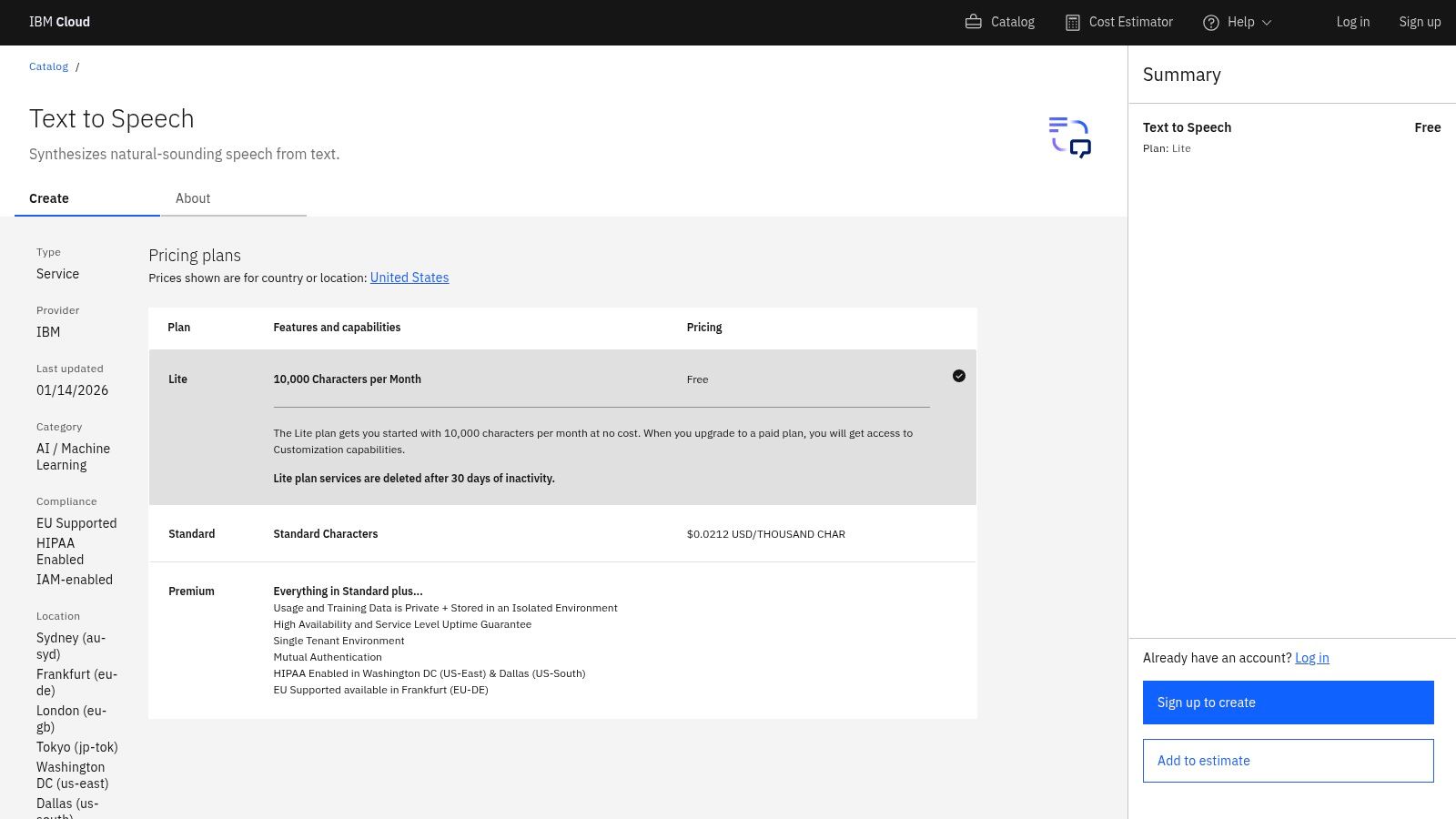
The platform is deeply integrated into the wider IBM Cloud catalog, which is both a strength and a potential learning curve. Provisioning the service feels more like spinning up a server than signing up for a creative tool. This approach, however, offers unparalleled control over cost estimation, regional data handling (including HIPAA-enabled regions), and seamless connections with other IBM AI services like Watson Assistant. It’s designed for system architects and developers who need to build TTS into a larger, governance-sensitive workflow, not for quickly narrating a blog post.
Key Features and My Take
- Enterprise Governance: Its main differentiator is its credibility and compliance posture. The ability to deploy in specific, secure regions is critical for businesses with strict data sovereignty requirements.
- Voice Customization: While not as simple as cloning tools, IBM offers robust customization options for training voices on specific company terminology or branding, which is essential for corporate training and customer service applications.
- Pricing and Access: The pricing is geared toward metered, enterprise usage and can be less transparent for casual users. You typically need an IBM Cloud account, and estimating costs requires using their catalog's calculator, which contrasts with the straightforward subscription tiers of other services.
Visit Website: https://cloud.ibm.com/catalog/services/text-to-speech
6. WellSaid Labs
Where many TTS tools focus on individual creators, WellSaid Labs carves out a niche for corporate and production teams. My experience testing their platform revealed a strong emphasis on brand consistency and professional workflows. Instead of a massive, user-generated voice library, they offer a curated roster of "AI Voice Avatars," each with a reliable and consistent output perfect for training modules, product demos, or corporate narration. This makes it a standout choice for businesses looking for one of the best text to speech software solutions that guarantees a polished, brand-safe sound every time.
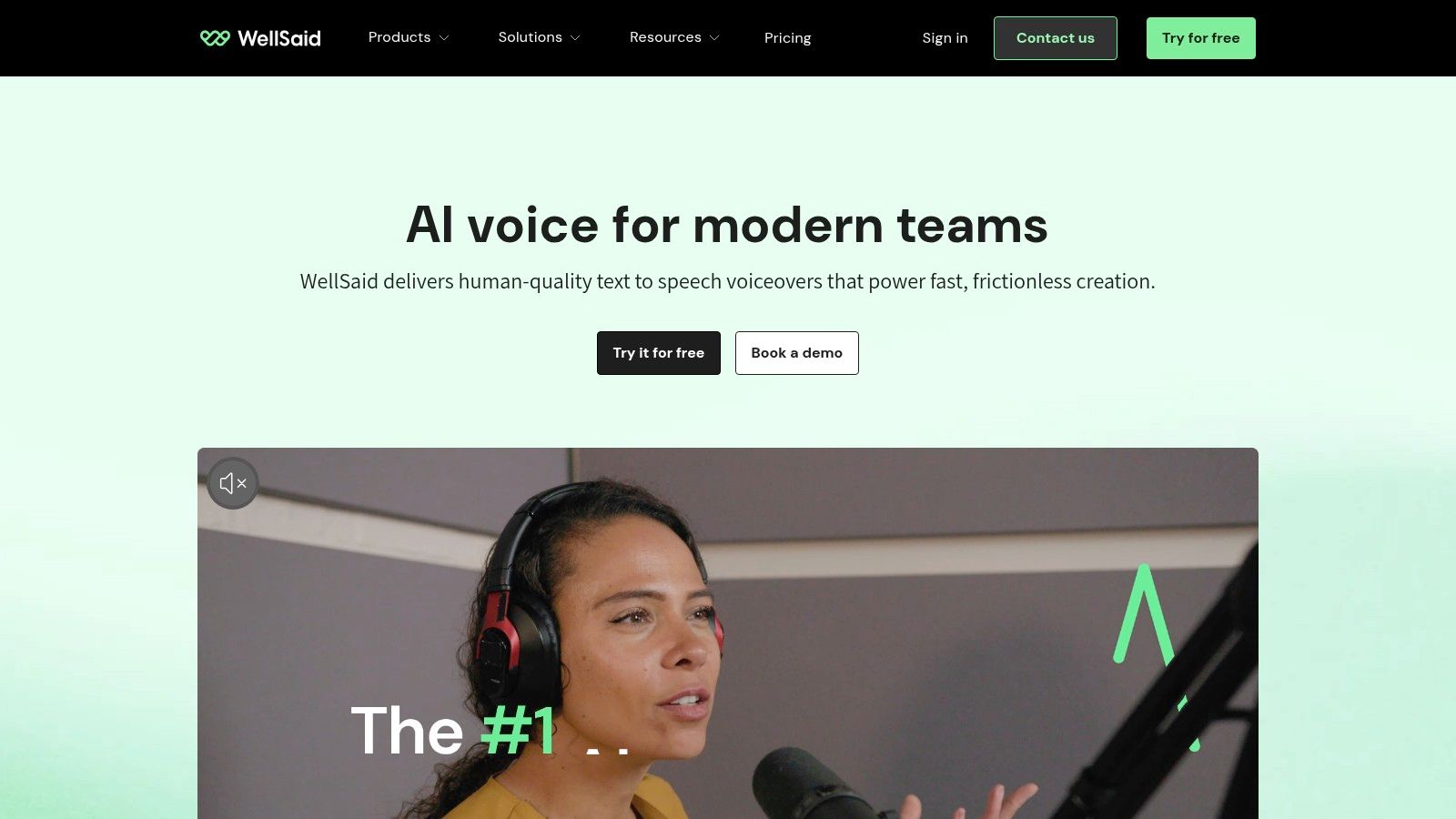
The platform is built around a "Studio" concept, which feels more like a collaborative production environment than a simple converter. You can create projects, manage scripts, and render audio in a way that feels organized and scalable for team use. The voices are impressively clear and professional, though they trade some of the raw emotional range of platforms like ElevenLabs for a more predictable and steady delivery. For a business producing hundreds of learning and development videos, that predictability is a massive asset.
Key Features and My Take
- Curated Voice Avatars: High-quality, consistent voices with full commercial rights on paid plans. This eliminates any ambiguity about usage rights for business content.
- Studio Workflow: The project-based interface is excellent for managing multiple scripts and audio files, a feature I found particularly useful for organizing larger narration jobs.
- Pricing Model: The plans are geared toward production needs, with specific download and project allowances. The entry price is higher than creator-focused tools, reflecting its enterprise and business audience.
- Team Collaboration: Higher-tier plans include features specifically for teams, reinforcing its position as a go-to tool for corporate environments.
Visit Website: https://wellsaidlabs.com
7. NaturalReader
NaturalReader has been a mainstay in the TTS space for years, and my experience with it has always highlighted its user-centric design. It masterfully serves two distinct audiences: individuals needing a simple tool for personal reading and commercial users requiring powerful AI voices. For anyone just wanting to listen to articles, documents, or emails, its suite of personal apps (web, mobile, and Chrome extension) is incredibly approachable and easy to use. It’s one of the first tools I recommend to friends who aren't tech-savvy but want to turn text into audio for study or accessibility.
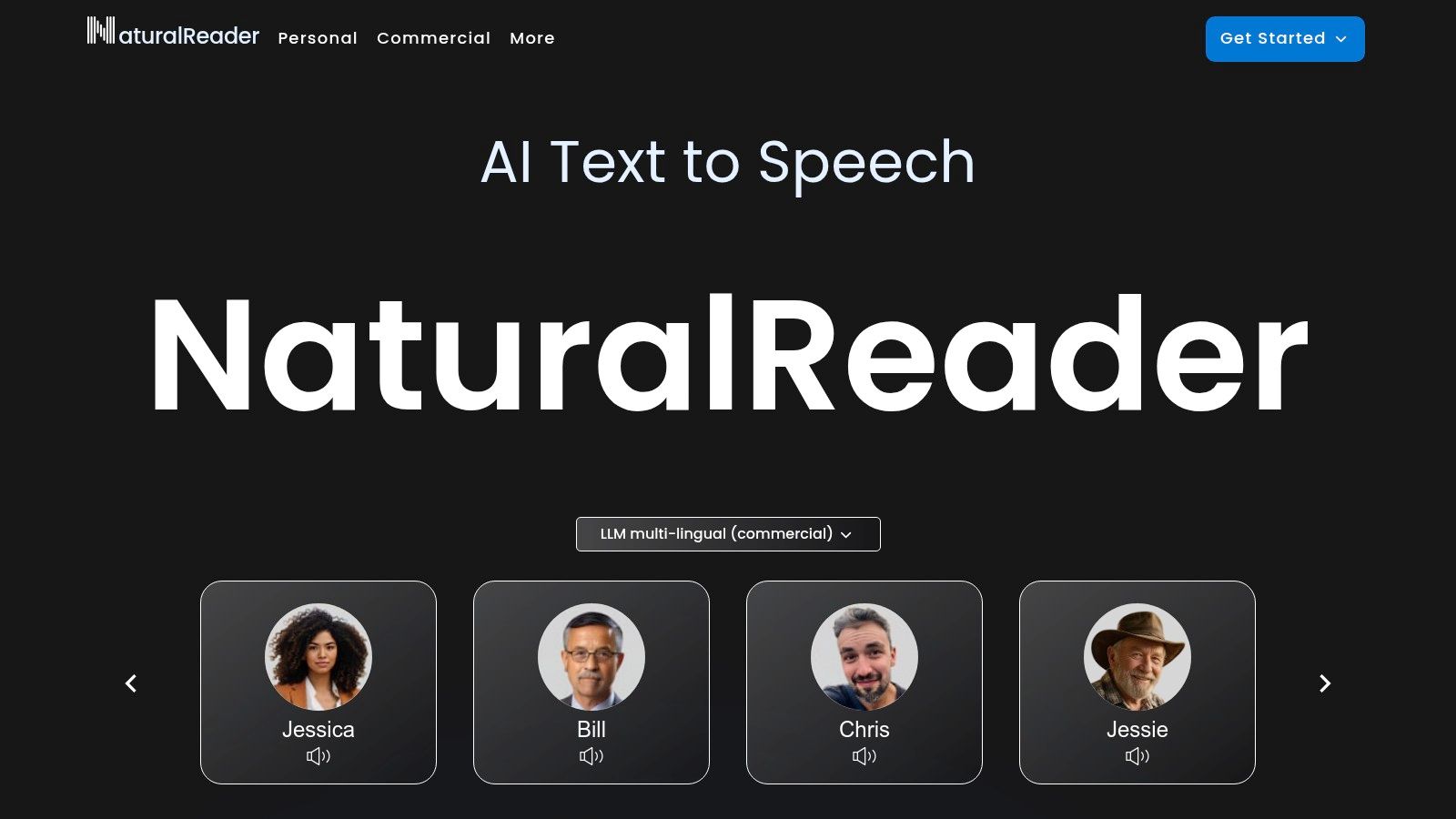
Where it competes as one of the best text to speech software options for creators is with its separate Commercial AI Voice Generator. This side of the platform offers higher-quality voices, voice cloning, and generous character quotas suitable for professional projects like e-learning, corporate narration, or YouTube videos. This clear separation between personal and commercial plans prevents confusion and ensures users pick the right license for their needs, which I find to be a responsible and transparent approach.
Key Features and My Take
- Platform Accessibility: With dedicated web, mobile (iOS/Android), and Chrome extension apps, it’s exceptionally easy to use for personal listening across all your devices.
- Distinct Licensing: I appreciate the clear divide. Personal plans are affordable for individual use, while the Commercial plan provides the features and legal rights needed for business projects.
- Commercial Features: The AI Voice Generator offers high-fidelity voices and team collaboration tools, making it a viable option for small to medium-sized businesses creating audio content. However, be aware that the personal plans strictly prohibit commercial use.
Visit Website: https://www.naturalreaders.com
8. Speechify
Speechify is one of the most popular and consumer-friendly gateways into the world of text to speech, and for good reason. My initial experience with it wasn't as a developer but as a user trying to get through a long reading list, and its reader app is incredibly polished for that purpose. It excels at turning documents, articles, and even physical books (via camera scan) into listenable audio, making it a fantastic tool for productivity and accessibility. It's this dual focus, serving both everyday users and developers, that makes it a unique contender.
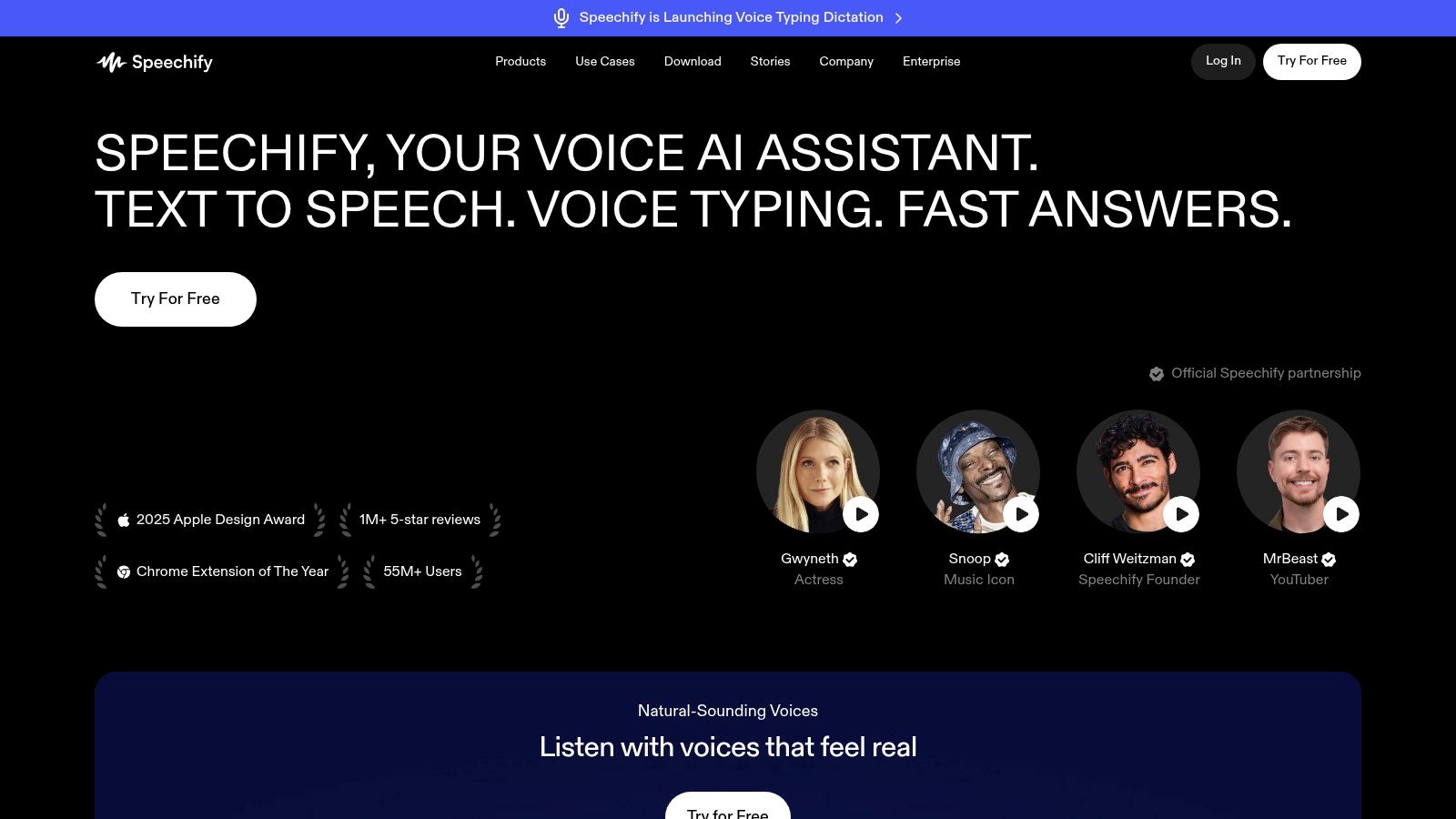
While many platforms focus solely on API-driven creation, Speechify has built an entire ecosystem. The app itself is cross-platform, syncing your library across devices seamlessly. For developers, their API (dubbed Simba) is straightforward, offering competitive pay-as-you-go pricing without the complexity of some other systems. While its core voices might not have the same dramatic flair as specialized studios, their clarity and consistency make it a reliable choice for both personal listening and integrating audio features into applications.
Key Features and My Take
- Massive Voice Library: With over 200 standard voices across more than 60 languages, the selection is vast, ensuring you can find a suitable option for almost any language or accent.
- Cross-Platform Reader App: The app is a standout feature. The ability to import content from virtually anywhere (web, docs, photos) and listen on any device is a huge productivity booster.
- Developer API: The pay-as-you-go pricing is simple and attractive for developers looking to add TTS functionality without a hefty subscription. It offers low latency and even includes voice cloning for paid users.
- Pricing Model: The consumer app pushes a premium subscription to unlock its best voices and features. The API, however, is priced separately and is more flexible for building products.
Visit Website: https://speechify.com
9. LOVO AI (Genny)
LOVO, particularly through its Genny platform, positions itself as more of an all-in-one AI content creation studio than just a simple voice generator. My experience with it felt geared towards creators who need to produce finished video or ad content quickly. Its strength lies in combining high-quality, directable voices with a suite of production tools like subtitling, sound effects, and even stock imagery. For marketers and e-learning developers, this integrated workflow can be a massive time-saver, eliminating the need to jump between multiple applications.
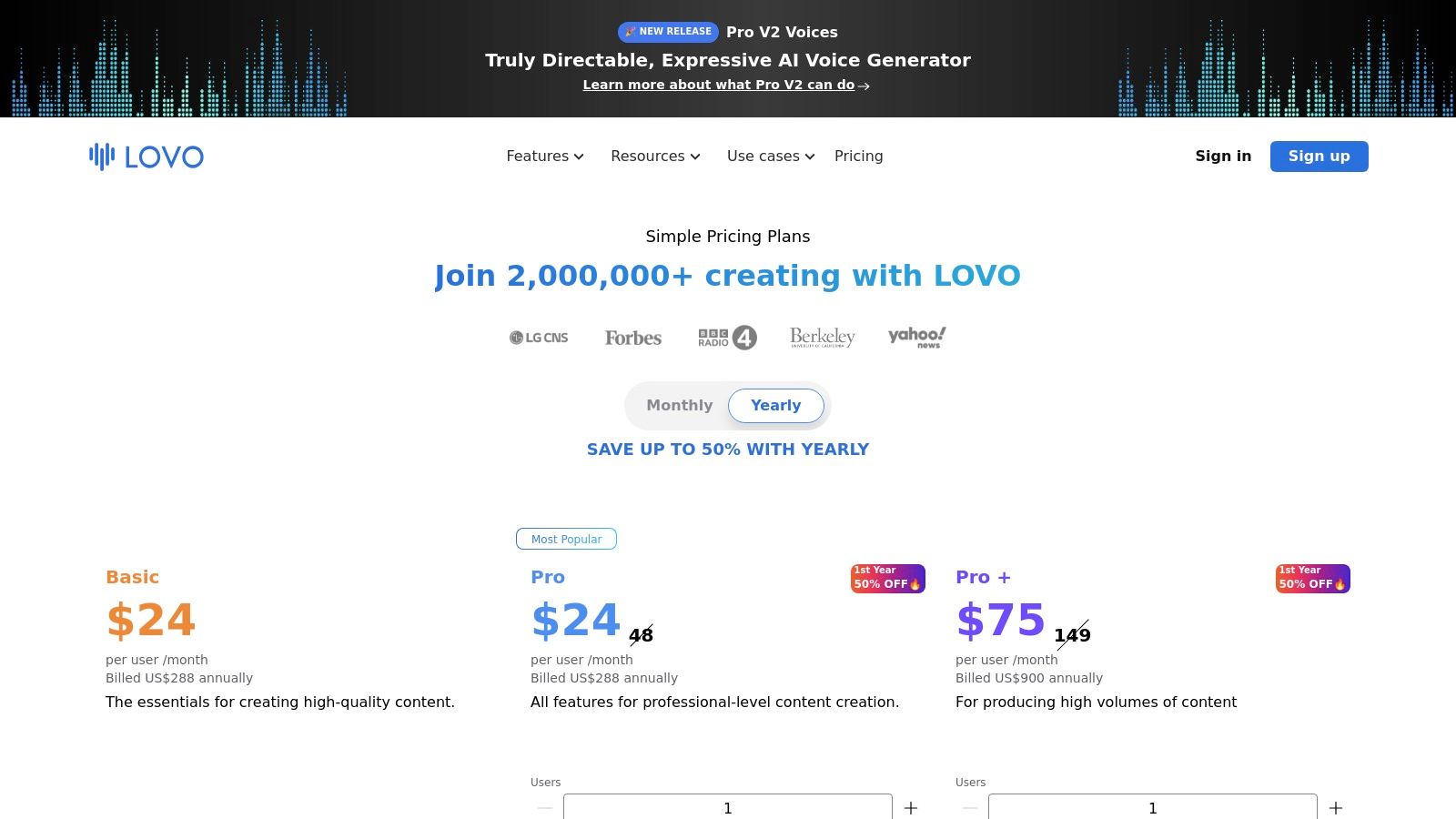
The platform’s "Pro V2" voices offer impressive emotional range and can be directed with emphasis and pacing controls, making them highly effective for promotional material. While the interface is intuitive, the unique pricing model, based on hours of generation time rather than characters, took a little getting used to. It's an interesting approach that might be more cost-effective for users with lots of short-form audio clips. You can see how it stacks up against others in our complete list of AI voice tools.
Key Features and My Take
- Creator-Centric Studio: Genny is a full production environment, not just a TTS tool. The ability to add SFX, music, and subtitles directly in the platform is a huge workflow advantage for video producers.
- Voice Quality: Offers over 500 voices in 100+ languages. The premium voices are very solid, though they don't quite reach the hyper-realism of the top-tier platforms in my tests.
- Pricing Model: Uses minutes/hours of generation time. The free plan provides 20 minutes to test things out, but the hour caps on paid plans might feel restrictive for high-volume podcast or audiobook production.
Visit Website: https://lovo.ai/pricing
10. Resemble AI
Resemble AI carves out a unique space for itself, focusing on providing a robust, API-first platform for developers and businesses building custom voice experiences. While testing it, I was immediately struck by its developer-centric approach. This isn't just a text-to-voice converter; it's a comprehensive toolkit for creating, managing, and deploying synthetic voices for applications, games, and brand identities. For those needing granular control and seamless integration, it's a powerful contender.
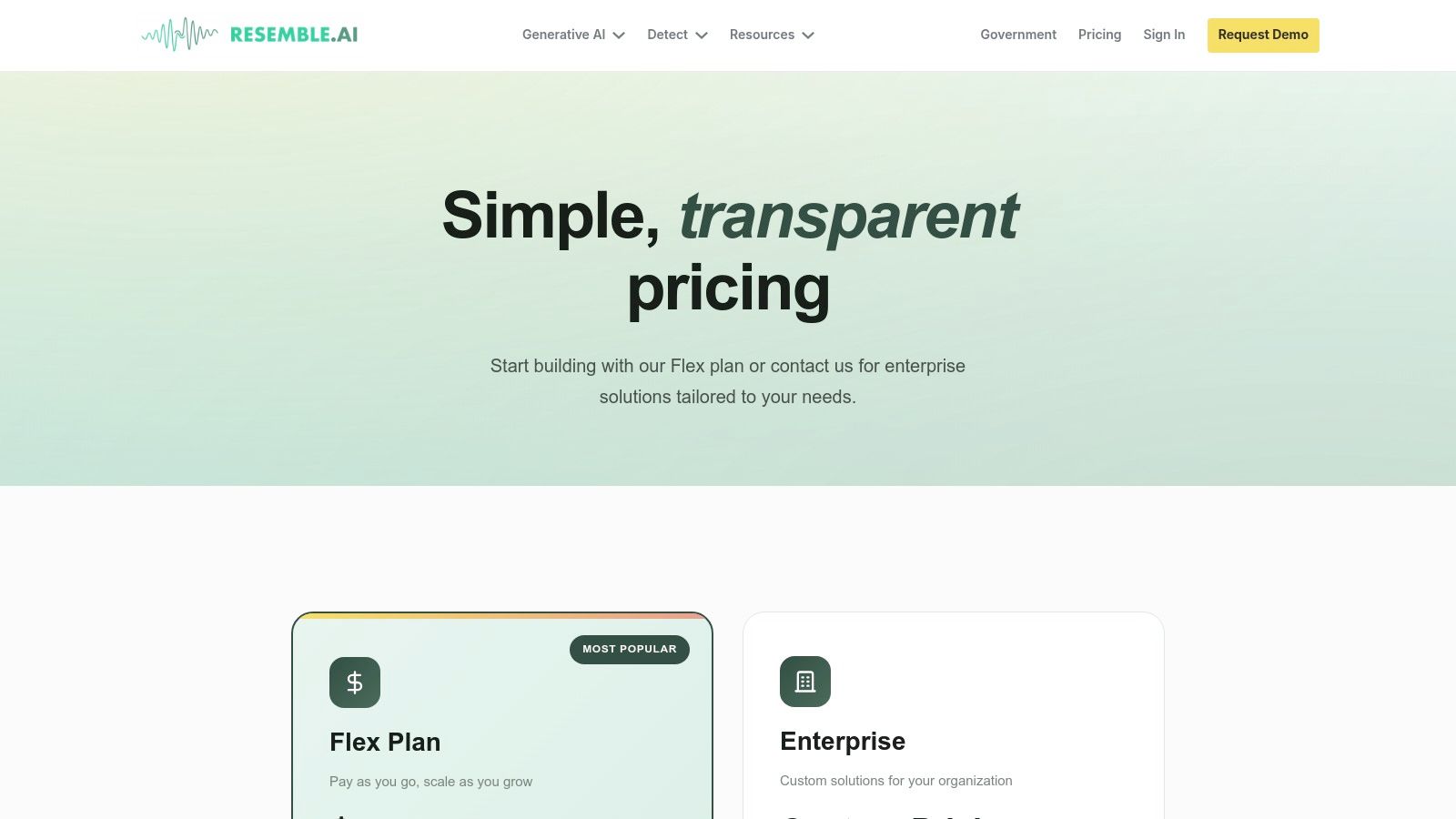
The platform truly shines with its low-latency API and features like voice cloning, which require a keen sense of ethical responsibility. Resemble AI handles this well, emphasizing security and consent in its cloning process. This focus is crucial, as I've explored in-depth when discussing the hidden risks of AI voice models. Their system is built for localization and real-time generation, making it ideal for dynamic, scalable audio needs rather than one-off narration projects.
Key Features and My Take
- API-Centric Design: The real-time WebSocket API is a standout feature for developers needing low-latency voice generation for interactive applications.
- High-Fidelity Output: On its higher tiers, Resemble offers crisp 48 kHz audio output, which is fantastic for professional-grade projects where quality is non-negotiable.
- Flexible Pricing: The pay-as-you-go credit system is a great entry point, and the credits never expire, which is a user-friendly touch. However, the pricing is based on seconds of audio, which requires a different calculation compared to the character-based models of many competitors.
Visit Website: https://www.resemble.ai/pricing/
11. ReadSpeaker
While many TTS tools focus on individual creators, ReadSpeaker carves out a niche in the enterprise and education sectors. My experience testing it revealed a platform built for large-scale, reliable deployment rather than a creative studio. It excels in accessibility solutions for websites, learning management systems (LMS), and public sector applications where compliance and consistency are paramount. For organizations needing robust, integrated voice solutions, ReadSpeaker offers a level of customization and deployment flexibility that consumer-grade tools simply can't match.
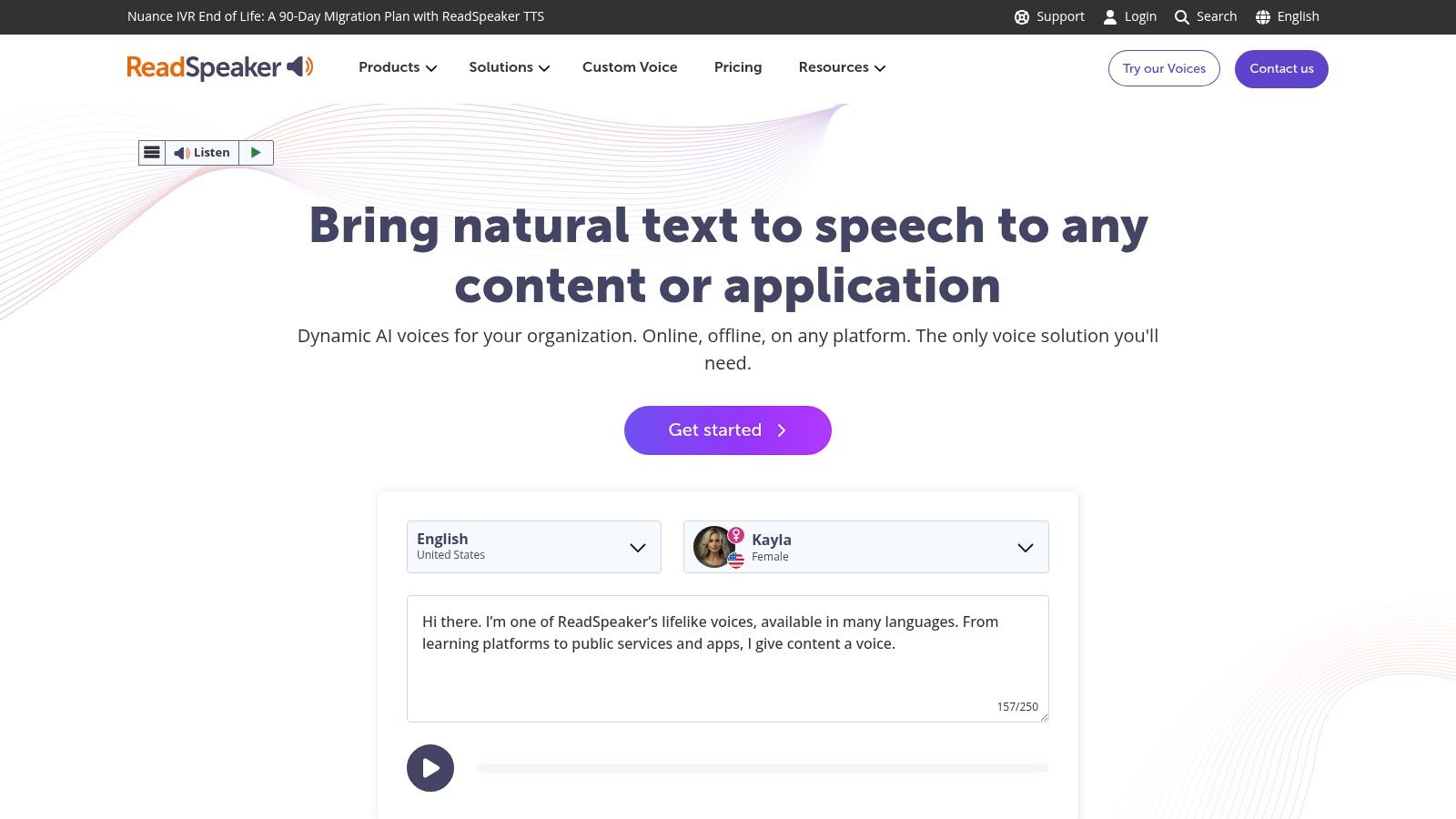
This is a solution designed for deep integration. With both cloud and on-premise options, it can fit into specific IT infrastructures, a key consideration for corporations and educational institutions with strict data policies. Their custom voice programs are particularly impressive, allowing an organization to create a unique brand voice. However, this enterprise focus means pricing is often quote-based and less transparent, which can be a barrier for smaller users or those just starting out with the best text to speech software for their projects.
Key Features and My Take
- Deployment Flexibility: Offers both on-premise and cloud-based solutions, which is rare and crucial for organizations with specific security or infrastructure requirements.
- Education & Accessibility Focus: Extensive integrations with major LMS platforms and a strong emphasis on web accessibility make it a leader in these specific use cases.
- Custom Voices: Provides custom voice creation services, allowing brands to develop a unique and consistent audio identity across all their platforms. The linguistic support behind this is top-notch.
- Pricing Model: Less of a self-service model. It’s geared toward enterprise sales cycles, requiring demos and quotes, making it less accessible for casual or small-scale use.
Visit Website: https://www.readspeaker.com
12. Narakeet
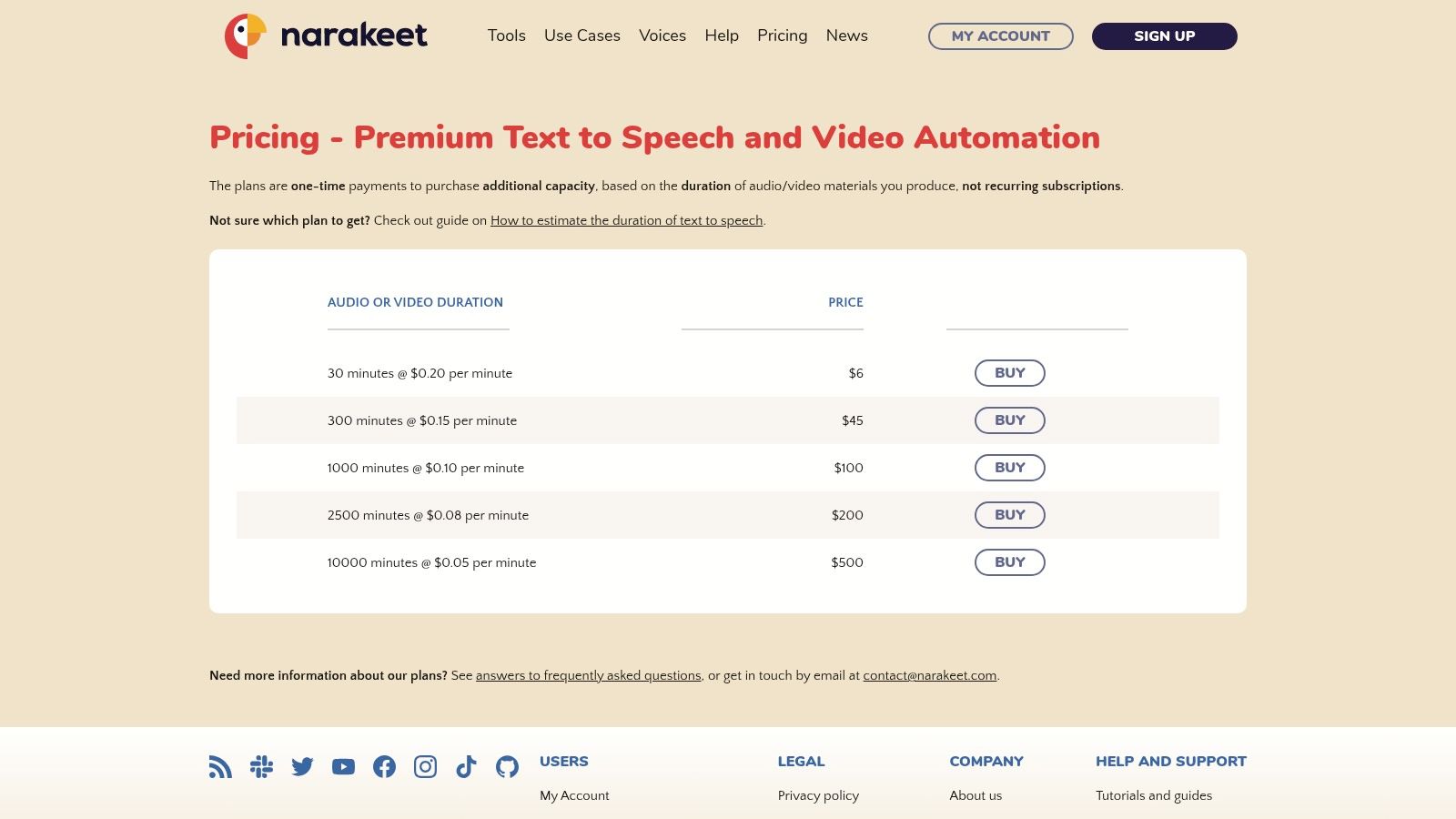
Narakeet takes a refreshingly different approach, positioning itself less as a real-time voice studio and more as a pragmatic content production engine. My experience with it felt very transactional, and I mean that in the best way possible. Instead of a monthly subscription, you buy packs of audio or video minutes. This pay-as-you-go model is perfect for creators who have sporadic needs or want to budget for a specific project without getting locked into a recurring fee, making it a standout contender for the best text to speech software for predictable, one-off projects.
The platform is designed for straightforward rendering rather than intricate vocal fine-tuning. You upload a script or a PowerPoint presentation, select a voice, and it generates the final audio or video file. This workflow is incredibly efficient for creating simple video lectures, corporate training modules, or YouTube voiceovers at scale. It's not the place for deep emotional control or voice cloning, but for pure utility and cost-effectiveness, it’s a powerful tool. All generated audio comes with commercial usage rights, which simplifies the process significantly.
Key Features and My Take
- Pay-Per-Minute Model: Its biggest differentiator. You buy a bundle of minutes (e.g., 30, 300, 1000) that you can use whenever you need. This is fantastic for budgeting and avoiding subscription fatigue.
- Video from Presentations: A killer feature for educators and marketers. It can turn a PowerPoint presentation into a narrated video automatically, syncing slides with the voiceover.
- Voice Quality: The voices are clear and professional, though they don't have the same emotional depth as specialized platforms like ElevenLabs. They are perfectly suited for informational and educational content.
Visit Website: https://www.narakeet.com
Top 12 Text-to-Speech Software Comparison
| Tool | Core features | Quality | Pricing / Value | Best fit | USP |
|---|---|---|---|---|---|
| ElevenLabs | Neural TTS, voice cloning, dubbing, studio + API | ★★★★★ — highly realistic | 💰 Credits model; free → business tiers | 👥 Creators, podcasters, studios, devs | ✨ Best-in-class natural voices; 🏆 studio + developer tooling |
| Amazon Polly (AWS) | Standard/Neural/Generative voices, SSML, SDKs | ★★★★ — reliable production grade | 💰 Pay-as-you-go; free tier for new accounts | 👥 Apps, IVR, large-scale AWS workloads | ✨ Predictable AWS billing + global infra |
| Google Cloud Text-to-Speech | Gemini/Neural/WaveNet tiers, SSML, multilingual | ★★★★ — flexible quality/cost trade-offs | 💰 Usage-based per model; clear pricing tables | 👥 Devs needing model choice & cloud integrations | ✨ Multiple model families for tuned cost/quality |
| Microsoft Azure AI Speech | Neural/custom voices, real-time & batch, containers | ★★★★ — enterprise-ready, scalable | 💰 Tiered pricing; commitment options | 👥 Enterprises standardizing on Azure | ✨ Container deployment + enterprise security |
| IBM Cloud Text to Speech | Enterprise security, customization, on-prem options | ★★★ — governance-focused | 💰 Quote-based / account pricing | 👥 Regulated orgs, HIPAA, governance teams | ✨ Strong compliance & on-prem flexibility |
| WellSaid Labs | Curated voice avatars, studio workflows, API | ★★★★ — consistent professional voices | 💰 Higher entry price; commercial licensing | 👥 L&D teams, marketing, brand voice owners | ✨ Brand-safe voice avatars; studio production focus |
| NaturalReader | Web/mobile reader, Chrome extension, commercial plan | ★★★★ — user-friendly for consumers | 💰 Free personal; paid commercial plans | 👥 Consumers, educators, small creators | ✨ Easy apps + clear personal vs commercial tiers |
| Speechify | Reader app (200+ voices), offline MP3, developer API | ★★★★ — consumer-friendly, large voice catalog | 💰 Subscription for reader; API payg | 👥 Readers, students, devs needing API | ✨ Strong cross-platform reader + straightforward API |
| LOVO AI (Genny) | Directable Pro voices, 500+ voices, subtitles & SFX | ★★★★ — creator-focused output options | 💰 Minutes/hour allowances; free trial | 👥 Video creators, e-learning, ads | ✨ Directable voices & rich export tools |
| Resemble AI | Voice cloning, real-time APIs, HD output, PAYG credits | ★★★★ — flexible & secure | 💰 PAYG credits + subscription options | 👥 Localization, product voices, dev teams | ✨ Low-latency real-time API; flexible credits |
| ReadSpeaker | On‑prem/cloud, LMS integrations, custom voices | ★★★★ — enterprise accessibility focus | 💰 Quote-based; bundle packs | 👥 Education, publishing, public sector | ✨ Strong licensing & custom voice programs |
| Narakeet | TTS + video automation, one-time minute packs | ★★★ — pragmatic rendering at scale | 💰 Prepaid per-minute packs; no sub | 👥 Creators who prefer pay-per-output | ✨ Simple per-minute budgeting; no subscription |
Final Thoughts
After spending weeks putting more than a dozen of the top text-to-speech platforms through their paces, one thing is crystal clear: the line between human and AI-generated speech is blurring faster than I ever thought possible. Ten years ago, reviewing software like this meant tolerating robotic, disjointed audio that was barely passable for basic accessibility. Today, I'm listening to AI voices from platforms like ElevenLabs and WellSaid Labs that have nuance, emotion, and pacing so realistic they could narrate an award-winning documentary.
This journey has been a fascinating look into the future of content creation. The best text to speech software is no longer just a utility; it's a creative partner. Whether you’re a podcaster needing a consistent voiceover, a marketer creating multilingual ad campaigns, or a developer building the next great app, the right tool can dramatically accelerate your workflow and elevate your final product.
Key Takeaways from Our TTS Deep Dive
Looking back at the hours of audio I've generated and critiqued, a few core truths have emerged. These are the takeaways that I believe matter most as you make your final decision.
- The "Best" Is Entirely Subjective: I can't stress this enough. The "best" tool for a solo podcaster on a budget (likely Narakeet or a generous free tier from Speechify) is completely different from what a large enterprise needs for its global e-learning platform (where Azure or ReadSpeaker might excel). Your specific use case, budget, and technical comfort level are the most critical factors.
- The Free Tier is Your Best Friend: Nearly every platform we tested offers a free plan or trial. Use them. Extensively. Listen to your own scripts read back in their voices. Test the interface. Don't just rely on the polished samples on their marketing pages. My experience showed that a voice that sounds great reading a generic sentence might struggle with industry-specific jargon or the unique cadence of your writing style.
- Customization is the New Frontier: Basic TTS is a solved problem. The real magic now lies in the ability to tweak and perfect the audio output. Tools that offer robust SSML (Speech Synthesis Markup Language) support, like those from Google, Amazon, and Microsoft, give developers granular control. Meanwhile, platforms like Resemble AI and LOVO AI are pushing the boundaries of AI voice editing, allowing you to direct the emotional performance almost like a film director. This is where the real power lies.
How to Choose Your Perfect TTS Partner
Feeling overwhelmed by the options? Don't be. Let's simplify the process. Start by answering these three questions to narrow down your search for the best text to speech software for you.
- What is my primary goal? Are you creating long-form audiobook narration, short-form social media video clips, or interactive voice responses for an app? For high-stakes, hyper-realistic voiceovers, premium tools like WellSaid Labs are worth the investment. For quick, easy video narration, Narakeet's simplicity is a huge win. For accessibility and personal reading, NaturalReader or Speechify are fantastic.
- What is my technical skill level? If you live and breathe APIs and developer consoles, the powerful engines from AWS, Google, and Microsoft will feel like a playground. If you want a user-friendly, plug-and-play web interface with zero coding required, platforms like ElevenLabs, LOVO, and Speechify are designed specifically for you.
- What are the ethical stakes? If you plan on using voice cloning features, the ethical considerations are paramount. Is your chosen provider transparent about safeguards? Do they require explicit consent? For professional projects, using platforms that prioritize ethical AI, like Resemble AI and WellSaid Labs, provides an essential layer of security and peace of mind.
Ultimately, the power of modern text-to-speech technology is transformative. It's democratizing content creation, making information more accessible, and opening up creative avenues that were once prohibitively expensive. The key is to find the tool that slots perfectly into your unique workflow, empowering you to create more, faster, and better than ever before.
Finding the right AI tool can be a game-changer for your productivity. At Exceptional AI, we cut through the noise by curating and reviewing the best AI software for creators and entrepreneurs just like you. Discover more tools that can transform your workflow at Exceptional AI.
Crafted with the Outrank app