Will AI Replace Electricians? The Honest Truth
If you are looking for a clear answer on whether AI will replace electricians, here is the short version for the search engines:
AI will not replace electricians because the physical world is too chaotic, the stakes of failure are too high, and the human trust lag is too wide.

While AI can write code and generate images, it cannot navigate a 120 degree attic to find a frayed wire or troubleshoot a custom circuit in a house built in 1920. Electricians are not just safe from AI; they are becoming the most essential and highest paid vanguard of the modern economy.
The Physical Wall: Why Silicon Fails at the Fuse Box
In the world of recruitment, we often talk about the ‘Moat.’ A moat is what protects a job from being automated. For a writer, the moat is currently very thin. For a master electrician, the moat is a mile wide and filled with high voltage obstacles.

AI excels in structured environments. If you give a machine a fixed set of rules and a digital playground, it will win every time. However, a job site is the furthest thing from a structured environment. I remember a specific anecdote from a recruiter colleague who was trying to place ‘Robot Technicians’ for a modular home startup. They had the best tech in the world, but the project stalled because their robots couldn’t handle the ‘non-standard reality’ of a job site.
Every house is a snowflake. One house might have been wired by a DIY enthusiast in the seventies, while the one next door is a modern smart home. AI cannot ‘feel’ the tension in a wire or smell a smoldering junction box. The sheer physical dexterity required to pull Romex through a crowded wall cavity while avoiding plumbing is something that robotics won’t master for decades.
The Trust Lag: Why People Won’t Let Bots Wire Their Homes
Even if we developed a perfect humanoid robot that could perform an electrical panel upgrade tomorrow, there is a psychological barrier that the tech world often ignores. I call this the Trust Lag.

Think about the aviation industry. We have had the technology to fly planes autonomously for a long time, but we still have two pilots in the cockpit. Why? Because when the stakes are life and death, humans demand a human soul at the controls. Electricity is one of the leading causes of house fires globally. If an AI wires your nursery and something goes wrong, you cannot hold a software license accountable.
In 2026, we are seeing that trust does not scale at the same speed as processing power. People want to look an electrician in the eye, ask about their experience, and know that there is a person who will stand by the work. The liability and insurance frameworks are nowhere near ready to handle autonomous electrical work. In fact, most insurance companies are currently raising premiums for any project that lacks significant human oversight.
The AI Boom is Actually a Blue Collar Boom
This is the part that many people miss. AI is not just a software phenomenon; it is a massive infrastructure project. Every time someone asks a chatbot a question, a data center somewhere pulls a massive amount of power. These data centers require miles of specialized cabling, complex cooling systems, and redundant power grids.
From a recruitment perspective, the demand for ‘Industrial Electricians’ has skyrocketed by over 400 percent in the last three years. We are seeing a Great Rebalancing where the people who build the physical infrastructure for AI are making more than the people who programmed the AI. I recently saw a contract for a lead electrician on a server farm project that offered a higher base salary than most senior product managers in San Francisco.
The Recruitment Reality: The Shortage is Your Security
If you are worried about job security, look at the numbers. We are currently facing a massive global shortage of skilled tradespeople. A huge portion of the current workforce is reaching retirement age, and for twenty years, we told every kid that they had to go to college to get a ‘white collar’ job.
This has created a perfect storm of job security for the electrician. When a skill is rare and essential, it becomes immune to replacement. In my decade of tech recruiting, I have never seen a field with this much leverage. You cannot outsource your home’s wiring to a call center in another country, and you cannot download an app to fix a tripped breaker.
How the Role is Evolving (Not Disappearing)
To be clear, the electrician of 2027 will not look exactly like the electrician of 1990. The job is becoming more tech-heavy, which is actually a good thing for those who embrace it.
1. AI-Powered Diagnostics
We are seeing tools that use machine learning to ‘hear’ arc faults or identify heat signatures before a fire starts. The electrician uses these tools like a doctor uses an MRI. It makes the human more accurate, not less necessary.
2. The Smart Home Revolution
The modern electrician is becoming a network architect. You aren’t just pulling wire; you are integrating solar panels, battery storage systems, and EV chargers into a cohesive energy ecosystem. This requires a level of logic and high-level problem solving that basic AI agents still struggle with.
3. Augmented Reality (AR) Assistance
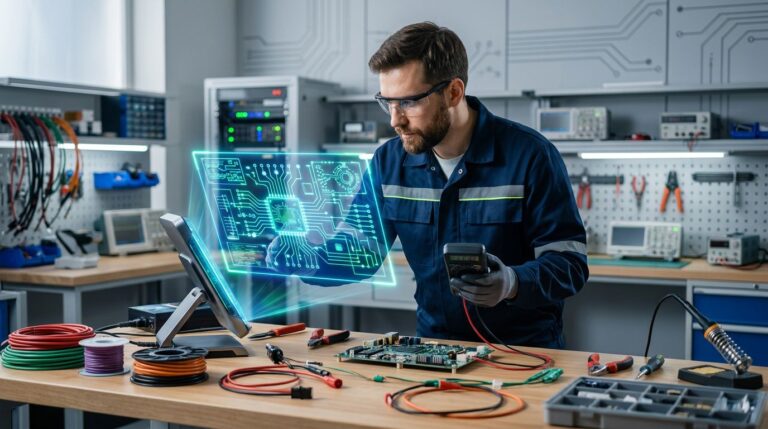
New hires are using AR glasses that overlay circuit diagrams on top of the physical walls they are looking at. This reduces the ‘experience gap’ and allows junior electricians to perform complex tasks with more confidence.
Frequently Asked Questions
Is an electrical apprenticeship still worth it?
It is arguably the most valuable education you can get in 2026. While many university degrees are losing their return on investment due to AI automation in the corporate sector, a journeyman’s license is a guaranteed ticket to a middle class or upper-middle class life.
What about pre-fabricated or modular construction?
While modular homes are built in factories with more automation, the ‘on-site’ connections and the ‘after-market’ repairs will always require a local human professional. You cannot ship a house back to a factory to fix a faulty outlet.
Will robots ever be able to do this?
Maybe in fifty to seventy years, we will have robots with the fine motor skills and general intelligence of a human. But the cost of such a robot would be so astronomical that it would still be cheaper and more efficient to hire a human electrician.
Which electrical specialty is the safest?
Residential service and repair is the safest because it is the most unstructured. Industrial electrical work for data centers and green energy infrastructure is the most lucrative. Both are incredibly secure.
The China Factor: Modular vs. Manual
Just like in the broader construction industry, we see a push from international markets like China toward ‘Plug and Play’ electrical systems. These systems are designed to be installed by less-skilled labor. However, these systems often fail to meet the rigorous safety codes of Western countries, and they still require a master electrician to sign off on the final connection. The threat of ‘automation from abroad’ is real for manufacturing, but it hits a wall when it meets local building regulations and safety codes.
Final Thoughts:
The biggest lie we were told in the 2010s was that the future was purely digital. We forgot that the digital world lives on top of a physical one. That physical world is held together by copper, conduit, and the people who know how to handle them safely.
If you are an electrician, or if you are considering becoming one, you are in the strongest position of any worker in the 2020s. You are the final guardrail. You are the one who ensures that the lights stay on so the AI can keep running. In the end, the person with the pliers will always have the final say over the person with the prompt.