AI Prompt Policy Template for Internal Teams in 2026
A loose prompt can expose more than a loose file share. In 2026, prompts often carry customer details, internal logic, pricing plans, code, and legal context.
While Generative AI tools boost workplace productivity and transform the workplace, if your teams use AI at work, you need more than an acceptable use memo. You need a clear AI prompt policy template that tells people what they may enter, which tools they may use, who approves shared prompts, and what records must be kept.
Key Takeaways
- Prompts in 2026 carry sensitive data like customer details, code, and legal context, requiring a dedicated AI prompt policy beyond general AI use memos to meet EU AI Act and enterprise audit standards.
- Reuse existing data classification (public, internal, confidential, restricted) for prompt rules on approved tools, data privacy, IP protection, role-based access, human oversight, and recordkeeping.
- Store approved prompts in a central library with versioning and owners; enforce via DLP, SSO, logging, and cross-functional ownership (IT, Security, Legal, Departments).
- Customize the provided template sections (Purpose, Scope, Data Restrictions, etc.) and include clear examples of acceptable vs. unacceptable practices to drive compliance.
- Tie policy to workflows for traceability, regular reviews (90/180 days), and evidence for auditors, aligning with NIST AI RMF under Chief AI Officer oversight.
Why prompt governance needs its own policy in 2026
Prompting used to look harmless. Now it sits at the point where employees, machine learning models, and company data meet in AI governance. That makes it an operational control for risk management, not a writing tip.
This year, the bar is higher. The EU AI Act is fully active by August 2026, and many enterprise buyers now expect audit trails, risk records, and named owners for AI use. A policy that only says “use AI responsibly” won’t help when security asks what data entered a model, or legal asks who approved a reusable prompt.
That is why prompt governance deserves its own layer as the strategic enablement of machine learning capabilities within a risk management framework. Teams need rules for input data, role-based access, review steps, versioning, and retirement of old prompts. Helpful background on enterprise prompt governance and broader AI governance policy design points in the same direction: treat prompts like business assets, not private notes.
If you can’t trace who wrote a shared prompt, what data it used, and who approved it, it isn’t ready for enterprise use.
What your internal prompt policy must cover
Start with your current data classification scheme. Then map each class to prompt rules, incorporating data privacy, security protocols, and protections for intellectual property. Security protocols must protect intellectual property and other sensitive information. Most teams already label data as public, internal, confidential, and restricted. Your AI policy should reuse those labels, because people follow rules faster when the language already exists.
This quick table shows the minimum structure of an AI policy template.
| Policy area | Minimum rule | Typical owner |
|---|---|---|
| Approved tools | Staff may use only company-approved AI tools and company-managed accounts | IT + Security |
| Data privacy | No sensitive information, such as PII, health data, payroll data, or customer secrets, in external models without approval | Privacy + Legal |
| Confidential and IP | No source code, trade secrets, M&A material, or privileged legal text in public tools | Legal + Security |
| Role-based access | Only approved roles may publish, edit, or connect shared prompts to systems | IT + Department owner |
| Human oversight | A person must review outputs used in contracts, hiring, finance, regulated work, or external communications | Business lead + Compliance |
| Recordkeeping | Log prompt version, model, tool, approval, date, use case, and retention period to meet compliance regulations | IT Governance |
A strong policy also states where prompts live. Don’t let teams store approved prompts in random chats or personal notes. Use a central library with owners, version history, and removal dates. Many organizations now adopt an access-tier model for AI systems so permissions match data sensitivity.
Finally, tie the policy to enforcement. A PDF alone won’t stop risky behavior. Use DLP, SSO, approved tool lists, and logging. That lines up with the growing push for operational prompt governance, where approval and audit controls live in the workflow.
A customizable AI prompt policy template teams can adapt
Copy-ready policy sections
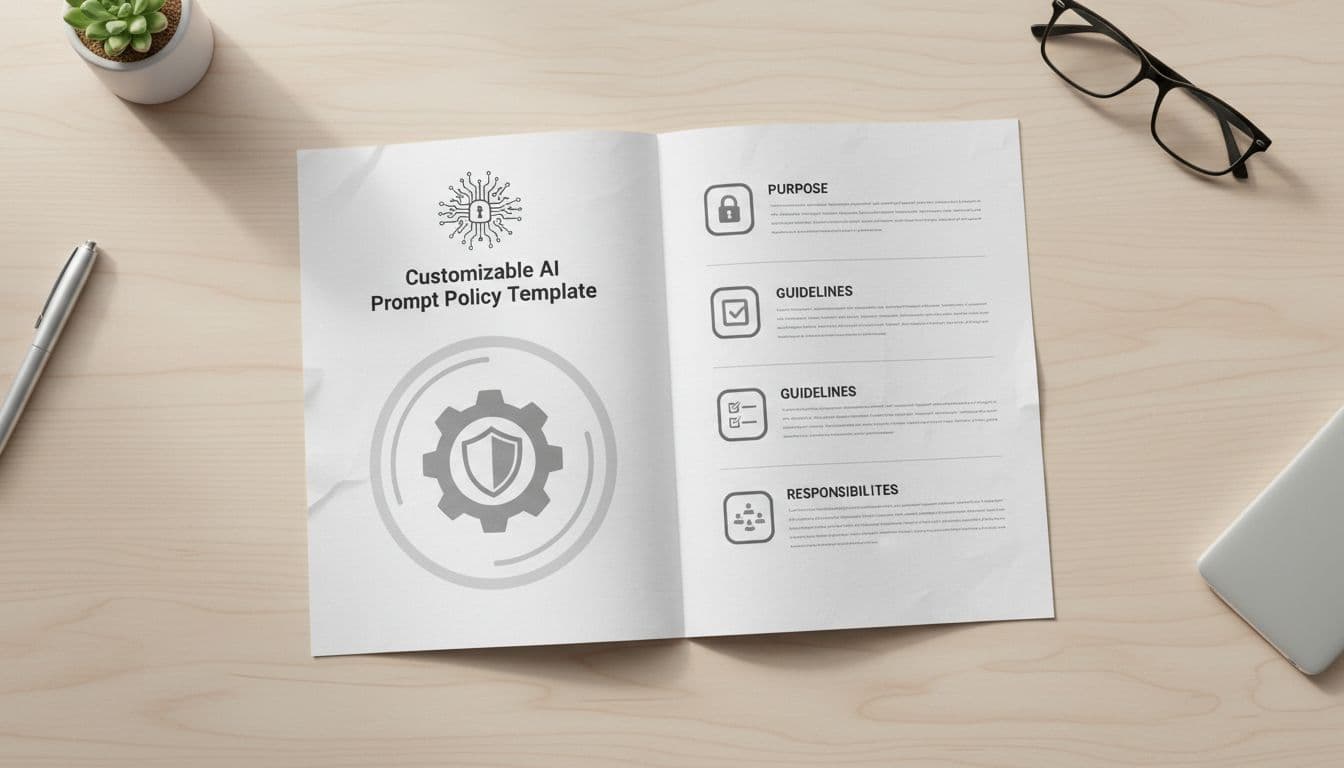
Use the section headers below as your starting draft. Replace bracketed fields with your own names, systems, and timelines.
- Purpose
“This policy governs how employees, contractors, and approved vendors create, store, approve, and use prompts and prompt templates in [Approved AI Tools] for company work.” - Scope
“This policy applies to all business units that use AI for drafting, analysis, summarization, coding, decision support, workflow automation, or customer communications.” - Approved tools and accounts
“Users may access AI tools only through [Approved Tool Register]. Personal accounts and unsanctioned browser tools may not be used for company work.” - Data restrictions
“Users must not enter Restricted Data into external AI services unless [Exception Authority] grants written approval. Restricted Data includes [PII], [source code], [trade secrets], [regulated records], and [privileged legal material].” - Prompt ownership and publishing
“Each shared prompt template must have a named owner in [Department]. Only [Role], as defined in job descriptions, may publish prompts to a team or company library.” - Human review requirement
“A qualified employee must review AI-generated output for output validation and bias prevention before use in customer-facing content, contracts, employment actions, financial reporting, security actions, or regulated submissions.” - Logging and retention
“The organization will retain prompt records, linked outputs, approver name, model used, and business purpose for [12/24] months.” - Review cadence
“Shared prompt templates must be reviewed every [90/180] days, and sooner if the model, use case, or risk level changes.”
Fill in these placeholders before release: approved tools, data tiers, exception path, retention period, review cycle, and named owners.
Acceptable and unacceptable prompt practices
A policy becomes real when examples are plain. These form the core of your acceptable use policy for prompts.
| Use case | Acceptable prompt practice | Unacceptable prompt practice |
|---|---|---|
| Support summary | “Summarize these redacted tickets and group by issue type” | “Summarize these raw tickets with names, phone numbers, and account IDs” |
| Contract help | “List clauses a lawyer should review in this draft” | “Rewrite this agreement and approve final legal language” |
| Code assistance | “Explain this masked function and suggest test cases” | “Paste production secrets, private repo code, or security keys (sensitive information) into a public generative AI model” |
Common mistakes are easy to spot. Teams often approve tools but ignore prompt libraries and prompt engineering. They require review for outputs but not for reusable prompts. They ban sensitive data, yet never define what counts as sensitive. Some keep no records, which means no evidence when an auditor asks for proof. Guidance on evidence requirements for AI use is worth reviewing before rollout, as are training programs on prompt best practices.

The cleanest ownership model is cross-functional, ensuring ethical AI use. Security sets control standards. Legal and privacy define restricted content. IT manages approved tools and access. Department heads, including HR professionals and product management, own business prompts. Internal audit checks that the process leaves records people can actually find.
Frequently Asked Questions
Why does prompt governance need its own policy in 2026?
Prompts now intersect employees, ML models, and company data, making them a key operational control for risk management. With the EU AI Act active and enterprise demands for audit trails, a vague “use AI responsibly” rule falls short when security or legal demands data entry records or prompt approvals. Treat prompts as business assets with rules for inputs, access, reviews, and versioning.
What must an internal AI prompt policy cover?
It should map data classifications to rules on approved tools/accounts, no sensitive PII/IP in external models without approval, role-based publishing, human review of outputs, and logging of versions/models/use cases. Centralize prompts in a library with history and retirement dates. Enforcement uses DLP, SSO, and workflow controls.
How do you implement acceptable prompt practices?
Provide plain examples: acceptable like “summarize redacted tickets” vs. unacceptable like pasting raw customer data or production code. Require named owners for shared prompts and reviews every 90/180 days or on changes. Train teams on prompt engineering alongside tool approvals.
Who owns and approves prompts under this policy?
Cross-functional: IT/Security for tools/access, Legal/Privacy for data/IP restrictions, Department heads for business prompts, Compliance for oversight. Only defined roles publish to libraries; exceptions need written approval. Internal audit verifies traceable records.
What’s the best way to roll out the policy template?
Copy the sections (Purpose, Scope, Approved Tools, etc.), fill placeholders with your tools/data tiers/retention/review cycles, and release with training. Make it short, usable, and tied to controls for busy teams. Align with NIST AI RMF via Chief AI Officer for strategic enablement.
Conclusion
A prompt policy works when it is short, usable, and tied to real controls. Your teams should know where prompts live, what data stays out, when a human must review output, and who signs off on shared use.
The best template is the one people can follow on a busy Tuesday. If your policy makes prompt use traceable, limited by role, and easy to audit, it is doing its job. Clear accountability measures and effective stakeholder communication, overseen by the Chief AI Officer, ensure the policy aligns with the NIST AI RMF.