
AI Audit Trail Policy Template for Internal Teams in 2026
The AI audit trail policy template addresses a key reality: An AI system can make a fast decision, but an auditor still asks slow questions. Who used it, what data went in, which version ran, and who approved the result?
A solid policy gives your team those answers on demand. It turns logs, approvals, and change records into evidence your operations, security, legal, and compliance teams can trust, while supporting AI governance and the ethical use of AI.
Key Takeaways
- A robust AI audit trail policy ensures traceability for AI decisions, capturing who used it, what data went in, model versions, and human approvals to satisfy auditors, regulators, and internal teams.
- Define scope with a system inventory, assign clear roles (business owners, IT/security, compliance), and log essential fields like event IDs, inputs/outputs, reviews, and changes while minimizing sensitive data via redaction or IDs.
- Secure logs as append-only, encrypted, and access-controlled; set risk-based retention (e.g., 180-365 days for routine logs, longer for reviews/incidents) to meet 2026 regulations like the EU AI Act.
- Use the ready-to-use template to mandate human oversight for high-risk cases, link incidents/vendor issues, and integrate with change management for tamper-resistant, audit-ready evidence.
What a 2026 policy needs to prove
In 2026, regulatory compliance and accountability drive the need for robust internal record-keeping. Your policy has to satisfy two audiences. Internal teams need records for investigations, quality checks, and change control. Auditors, customers, and regulators need proof that AI use is traceable.
That pressure is getting more concrete. The EU AI Act reaches a major compliance point for high-risk systems, emphasizing risk assessment, on August 2, 2026, and frameworks like ISO/IEC 42001 and the NIST AI RMF push organizations toward documented oversight and logging. If you want a concise map of the technical side, this overview of AI audit logging requirements is a useful reference.
A workable policy should make five points clear. First, it defines which AI systems fall in scope, including maintaining a system inventory to prevent shadow AI usage, which complicates auditing. Next, it assigns owners, overseen by a governance committee. It also states what must be logged, how logs are protected, and when humans must review or override outputs. Finally, it explains how incidents, vendor issues, and system changes are recorded.
This ownership model keeps the policy practical:
| Role | Primary responsibility |
|---|---|
| Business owner | Approves use cases, risk level, and human review rules |
| IT and security | Protects log integrity, access, storage, and monitoring |
| Compliance and legal | Maps controls to laws, contracts, and retention rules |
| System admin or product owner | Maintains model, tool, connector, and change records |
If you can’t recreate an AI-assisted decision later, your audit trail is incomplete.
Required logging fields and control points
Logs fail when they only capture prompts and outputs. A useful trail connects people, models, model documentation, data, approvals, and changes into one record.

For a broader reference, this practical audit trail checklist aligns well with what most internal teams need.
Use this comprehensive audit checklist for your required logging fields:
- A unique event ID, session ID, timestamp, and time zone.
- The requesting user, department, device, or service account.
- The generative AI tool, vendor, model name, version for LLM observability, and environment.
- The business process or use case tied to the event.
- The input reference, with redaction or tokenization when content is sensitive.
- Any data sources, retrieval results, file IDs, or knowledge base versions used.
- The output, score, recommendation, or action proposed by the system.
- Whether the output was auto-executed, reviewed, edited, rejected, or overridden.
- The human reviewer, decision time, and reason for the decision, including bias and fairness checks.
- Access events for the audit record itself, including reads, exports, and admin actions.
- Related change tickets, approval IDs, incident IDs, or exception records.
- Vendor API call details when a third-party tool performs part of the workflow.
Most importantly, minimize data. Keep what you need to reconstruct the event, not every raw prompt forever. Use IDs, hashes, redacted excerpts, and linked records when full content creates privacy or secrecy risk.
Access controls, data privacy, and data security and protection matter just as much. Audit records should be append-only, encrypted, and limited to approved roles. If someone can quietly alter or delete logs, the policy looks good on paper but fails in practice. For higher-risk workflows, signed logs or WORM-style storage are worth the extra effort.
Ready-to-use AI audit trail policy template
Most internal teams need a ready-to-use AI policy template they can adopt this quarter, not a long legal memo. Use the AI usage policy template below as a base, then adjust the scope, retention periods, and approval paths for your environment.
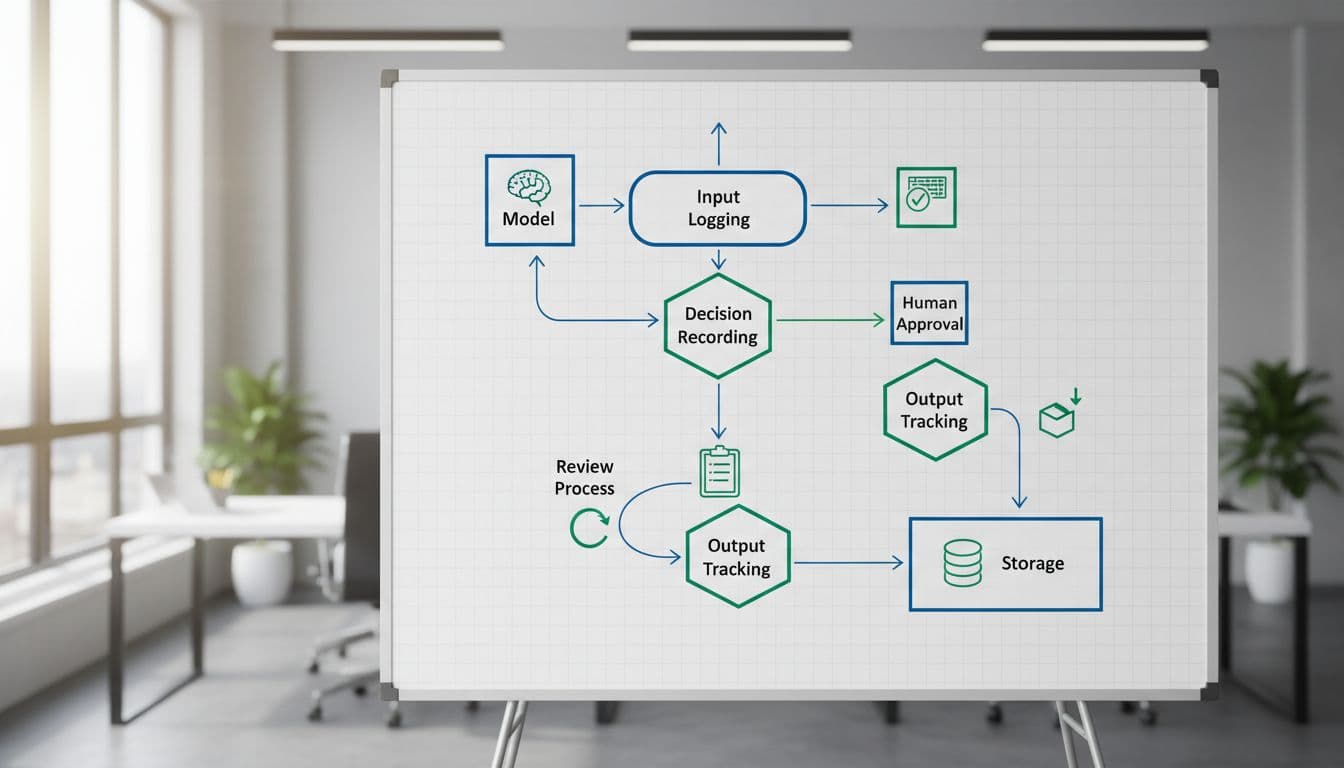
Sample policy language
Replace the bracketed items before approval.
- Policy name: [AI Audit Trail and Logging Policy].
- Effective date: [Month Day, 2026]. Policy owner: [Role or team].
- This policy applies to [business units], [AI systems], [agents], and [third-party AI tools] used in [production, internal operations, customer support, HR, finance, security, or other listed workflows].
- [Organization] will create an append-only audit record for each material AI-assisted action that affects [customer outcomes, employee decisions, financial records, security actions, or regulated reporting].
- Each audit record must identify the requesting user or service account, the tool and model version, the input reference, the output, the data sources used, and any human approval, rejection, edit, or override.
- Teams will collect the minimum data needed for traceability, respecting data classification levels. Personal data, protected data, and confidential inputs must be redacted, tokenized, or referenced by ID unless full content is required for legal or operational reasons.
- Human review is required for [high-risk use cases] to provide human oversight. Reviewers must record their name, timestamp, decision, and reason.
- Changes to prompts, models, retrieval settings, thresholds, plugins, connectors, or access rights require a ticket in [system], approval from [role], and a linked production change record.
- Security will restrict audit log access to [approved roles]. All read, export, edit, and delete attempts must be logged and reviewed.
- Incidents involving incorrect output, bias, data leakage, unauthorized access, vendor failure, or policy breach must be reported within [X hours] as part of the incident response plan. The incident record must link the affected sessions, users, notifications, and corrective actions.
- Third-party AI providers must undergo vendor security evaluation, support exportable logs or equivalent evidence through vendor contract clauses, and meet logging standards. Tools that cannot meet logging requirements are not approved for [production use].
Data retention requirements and ownership
Set retention by risk, not convenience.
| Record type | Suggested baseline |
|---|---|
| Routine operational AI logs | [180 to 365 days] |
| Human review and override records | [2 to 7 years] |
| Incident, exception, and legal hold records | [Case-based retention] |
Keep one policy owner, but review the policy with compliance, IT, security, and the business sponsor. Also, pair it with a broader acceptable use policy template so employee behavior rules and audit evidence stay aligned.
Frequently Asked Questions
What is an AI audit trail policy?
An AI audit trail policy requires logging key details of AI usage—such as users, models, inputs/outputs, and human reviews—to recreate decisions for audits or investigations. It prevents shadow AI by maintaining a system inventory and assigns roles for ownership. This turns raw logs into trusted evidence for compliance, security, and operations.
Why is an AI audit trail needed in 2026?
Regulations like the EU AI Act’s high-risk compliance deadline on August 2, 2026, plus ISO/IEC 42001 and NIST AI RMF, demand documented oversight and logging. Internal teams need it for investigations and change control, while auditors/regulators require proof of traceability. Without it, AI decisions can’t be verified, risking fines or trust issues.
What fields must be logged in an AI audit trail?
Essential fields include unique event/session IDs, timestamps, users/departments, tool/model versions, input references (redacted if sensitive), outputs/actions, human review decisions, data sources, and linked changes/incidents. Vendor API details and access to logs themselves are also key. Focus on reconstructible data, not raw prompts, to balance traceability and privacy.
How should AI audit logs be secured and retained?
Logs must be append-only, encrypted, with access restricted to approved roles and all interactions logged; consider signed or WORM storage for high-risk cases. Retention varies by risk: 180-365 days for routine logs, 2-7 years for reviews, and case-based for incidents/legal holds. Pair with data privacy controls like tokenization to protect sensitive content.
Can teams use the provided policy template as-is?
Yes, adapt the sample language for your scope, retention, and workflows—replace brackets with specifics like business units, high-risk cases, and tools. Review with compliance/IT/business, link to incident response and vendor clauses, and pair with an acceptable use policy. Update as your AI stack or regulations evolve.
Conclusion
Good AI governance is boring in the best way. It gives your team clear evidence when someone asks what happened, who approved it, and what changed.
A strong AI audit trail policy fosters transparency throughout the organization by capturing decisions, human review, access, incidents, vendor activity, and retention rules in one system of record. Its ultimate goal is producing audit-ready documentation that supports ongoing monitoring and evaluation. Keep it simple, make the logs tamper-resistant, and update the policy whenever your AI stack or risk profile changes.