
AI Model Card Template for Internal Teams in 2026
A strong model can still fail internal review if nobody can explain how it works, where it fails, or who approved it. In 2026, an AI model card template is part release record, part risk control, and part handoff document.
For internal teams, the best template is short, repeatable, and tied to launch gates. It should work for LLMs, RAG systems, classic ML models, and vendor-hosted tools without turning into a 20-page memo.
What an internal AI model card must capture in 2026
Older model cards often stopped at training data and accuracy. That is not enough now. Generative AI systems add prompts, retrieval sources, tool access, output filters, and human review steps. Security teams also need privacy controls, logging, retention, and approved usage boundaries.
In practice, many teams now pair a model card with a system-level record. The Open Model Card spec is a helpful starting point, while this AI system card template shows how teams add registry IDs, risk tiers, and governance fields.
Your reusable template should capture six things every time:
- The model’s identity, owners, version, deployment status, and linked ticket or registry ID.
- The intended use, intended users, and prohibited use, written in plain business language.
- The data story, including sources, date ranges, licenses, sensitive fields, and provenance.
- The evaluation method, with datasets, reviewers, thresholds, and known limits.
- The human oversight path, especially for high-impact outputs or regulated decisions.
- The monitoring plan, version history, incident triggers, and retirement conditions.
If the card does not say what the model should never do, the card is incomplete.
Keep the main card concise. Link to red-team reports, privacy reviews, benchmark packs, and architecture docs instead of copying them in full. That makes updates faster, and it gives reviewers one source of truth.
A copy-and-paste AI model card template
Use the template below as the front page of record. Then attach evidence links after approval.
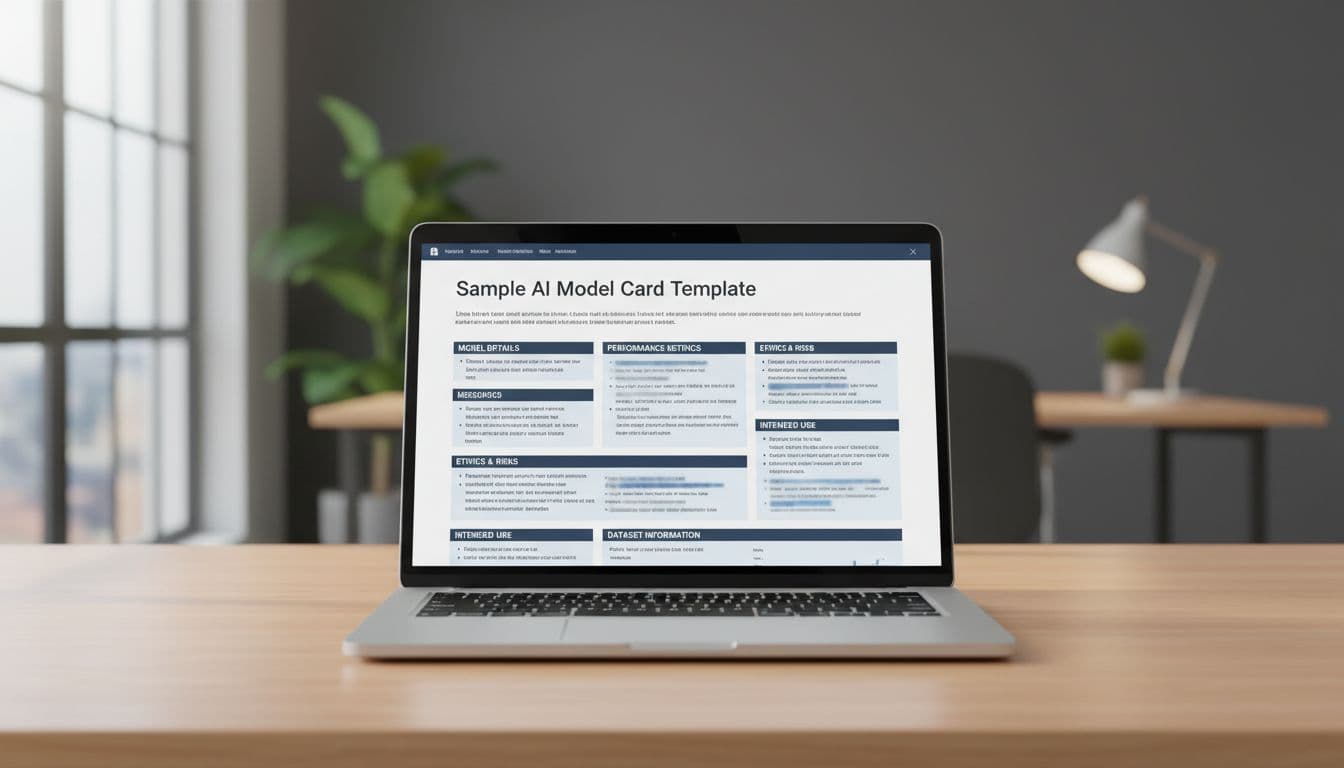
Sample template block
Model name: Contract Review Assistant
Registry ID: MOD-2026-014
Version: 2.3.1
Model type: Hosted LLM with RAG
Base model and vendor: Approved external model through internal gateway
Business owner: Legal Operations Director
Technical owner: Applied AI Platform Team
Intended users: In-house attorneys and paralegals
Intended use: Draft clause summaries and flag unusual contract terms
Prohibited use: Final legal advice, external client communications, or automatic contract approval
Input data: Approved contract corpus from SharePoint, redacted before indexing
Sensitive data: PII and confidential commercial terms may appear; logs retained 30 days
Provenance: Retrieval corpus KB-112, prompt pack PR-33, policy set GP-7
Evaluation method: Internal legal benchmark, citation checks, adversarial prompt tests, human review sample
Key results: Citation accuracy 94%, escalation rate 11%, hallucination rate 3.2% on test set
Known limits: Weak on scanned PDFs, uncommon regional clauses, and missing source citations
Human oversight: Attorney review required before any output is used in a live matter
Security and privacy controls: SSO, role-based access, audit logging, blocked public connectors
Monitoring: Track citation failure, latency, policy violations, user override rate, and incident volume
Approval status: Approved for internal legal review only
Last review date: 2026-04-12
Next review trigger: Base model change, corpus update, policy incident, or quarterly review
Each field should be factual, dated, and owned by a named team. Write the intended use as a business task, not a slogan. For evaluations, include the test set name, pass threshold, reviewer, and review date. For generative AI, also record prompt version, retrieval index version, tool permissions, and fallback behavior.
If you want another reference point, this enterprise model card template is close to what many internal teams need.
Approval, monitoring, and versioning after launch
A model card is not finished at release. It should update whenever the model, prompt stack, retrieval corpus, tool access, or policy boundary changes. That matters even more with vendor models, because silent upstream changes can affect quality, cost, and risk.
Managed platforms increasingly support this workflow. For example, this Vertex AI model card walkthrough shows how teams connect documentation to deployed assets.

Your card should also define re-approval triggers. Good examples include a base model swap, a new market launch, a changed retention policy, a new high-risk use case, or a material drift event. Without those triggers, teams often keep old approvals attached to new behavior.
Before approval or re-approval, confirm five things:
- Evaluation evidence is attached and dated.
- Human review steps are clear for high-impact outputs.
- Privacy, logging, and retention rules match current policy.
- Model, prompt, tools, and data sources are version-pinned.
- Alerts, rollback owner, and incident path are documented.
Monitoring should cover more than model quality. Track business outcomes, safety events, security exceptions, user overrides, and cost spikes. If you run an agentic workflow, monitor tool misuse and failed actions too. A short changelog inside the card helps auditors, incident responders, and platform teams see what changed and why.
A practical AI model card template does one job well: it makes the model understandable under pressure. When review time comes, nobody should have to hunt through chats, tickets, or slide decks.
Keep the card short, but make it strict about ownership, evidence, and change history. That is what turns model documentation from a paper exercise into an operating control.