
Bring Your Own AI Policy Template for Employees in 2026
Your employees are already using generative AI at work, even if your company never approved it. That makes a bring your own ai policy less like a nice-to-have and more like a seat belt.
In April 2026, the risk is hard to ignore. Recent reporting points to 78% of knowledge workers using shadow IT with unapproved personal AI tools at work, while data leakage has jumped sharply. With the EU AI Act moving into fuller effect in August 2026, compliance risks make silence a policy choice.
Key Takeaways
- Employees are already using generative AI tools at work (78% shadow IT, 67% for productivity), but only 18% of companies have policies, leading to 156% surge in data leakage risks amid 2026 EU AI Act enforcement.
- A strong bring your own ai policy balances innovation and risk by approving tools, banning sensitive data in public AI, requiring human review of outputs, restricting high-impact AI decisions, and mandating logging/reporting.
- Use the 8-clause template as a customizable starting point: define scope, limit tools/data, enforce reviews/accountability, and get HR/legal/IT input before rollout.
- Rollout effectively with discovery of current usage, three-tier tool categories (approved/conditional/banned), simple approval flows, targeted training, and quarterly reviews tied to frameworks like NIST AI RMF.
Why a BYOAI Policy Matters in 2026
BYOAI means employees use their own AI accounts, subscriptions, or browser tools for work. If you need a quick plain-language definition, Microsoft has a useful explainer on what BYOAI means at work.
What makes this urgent is the gap between use and control, stemming from a lack of IT oversight. Recent 2026 reporting shows 67% of employees already use generative AI tools for work to boost employee productivity, yet only 18% of companies have rules in place. At the same time, sensitive data exposure tied to AI use has surged by 156%, amplifying enterprise risks. That gap is where mistakes happen.

A good policy does not ban useful generative AI tools. Instead, it draws clear lines around data, decisions, and accountability. It tells employees what they can use, what they can never paste into a tool, and when a human must step in. That balance matters because most companies don’t want to stop AI adoption, they want to stop avoidable risk.
The table below shows the minimum elements most first-draft policies need, with data privacy as a core concern when using large language models.
| Core element | Minimum rule | Primary owner |
|---|---|---|
| Tool approval | Use only approved or conditionally approved AI tools | IT and security |
| Data handling | Never enter confidential, personal, regulated, or client data into public AI tools | All employees |
| Human review | A person must review outputs before use or sharing | Employee and manager |
| High-impact use | No AI-only decisions for hiring, pay, discipline, legal, safety, or compliance matters | HR, legal, business lead |
| Logging and reporting | Record approved use cases and report incidents fast | Team lead and compliance |
That keeps the policy short while covering the issues security, HR, and auditors care about most. For broader governance ideas, this guide on governing BYOAI without blocking innovation is a helpful companion read.
A customizable policy template employees can follow
First-draft template
Use this as a starting point. It is educational, not legal advice.
- [Company Name] permits limited use of approved AI tools for work tasks that improve speed or quality and comply with this policy.
- This policy applies to all employees, contractors, and interns using AI for company work, whether the tool is company-paid or a personal ai subscription.
- Employees may use only tools on the approved list, or tools with written approval from [Team/Role]. Personal AI browser extensions, plug-ins, or APIs need approval before connection to company systems.
- Employees must not enter confidential business data, proprietary data, intellectual property, client data, personal data, financial records, source code, trade secrets, or regulated information into public AI tools unless the tool is approved for that data class.
- Employees must review and verify all ai-generated content before using it in work product, customer communications, decisions, or published material.
- AI may not make final decisions on hiring, promotion, pay, discipline, legal advice, compliance actions, safety decisions, or any regulated activity without documented human review and approval.
- Employees must disclose AI assistance when required by [Company Name], keep records of approved high-risk use cases, and report suspected data leaks, harmful output, or policy breaches within [24 hours].
- Violations, including falling short of security standards, may lead to removal of access, corrective training, disciplinary action, or other steps under existing company policies.
Keep the brackets. Then let HR, legal, privacy, and security fill them in before rollout.
What each clause means in plain English
Clauses 1 and 2 define the lane. They tell staff that AI is allowed, but only for work that fits company rules. They also stop the common dodge of saying, “It was my own account.”
Clause 3 controls tool sprawl by limiting use to sanctioned ai tools on the approved list. Without it, every team picks unsanctioned ai tools like a different assistant, extension, or API. That makes review, logging, and vendor checks much harder.
Clause 4 is the hard line. If your policy gets only one sentence remembered, make it this one: public AI tools are not a safe place for sensitive company data unless security has approved that use.
Clause 5 keeps humans in charge and upholds academic integrity in work product. AI can draft, summarize, or suggest. It should not publish, promise, approve, or decide on its own.
Clause 6 carves out high-risk work. Hiring, pay, discipline, legal, and safety choices need extra care because bias, error, or weak records can create real harm. If your company operates in the EU or regulated sectors, this part matters even more as rules tighten in 2026.
Clauses 7 and 8 create accountability. Logs help with audits and incident response. Clear consequences also show that the policy is real, not wallpaper. If you want to compare formats, this AI acceptable use policy template shows similar sections in a workplace context.
How to roll out the policy without slowing good work
A policy fails when it lives only in the handbook. Start with discovery as a key part of ai governance. Ask teams which tools they already use, what they use them for, and what data they enter. You can’t govern what you can’t see.
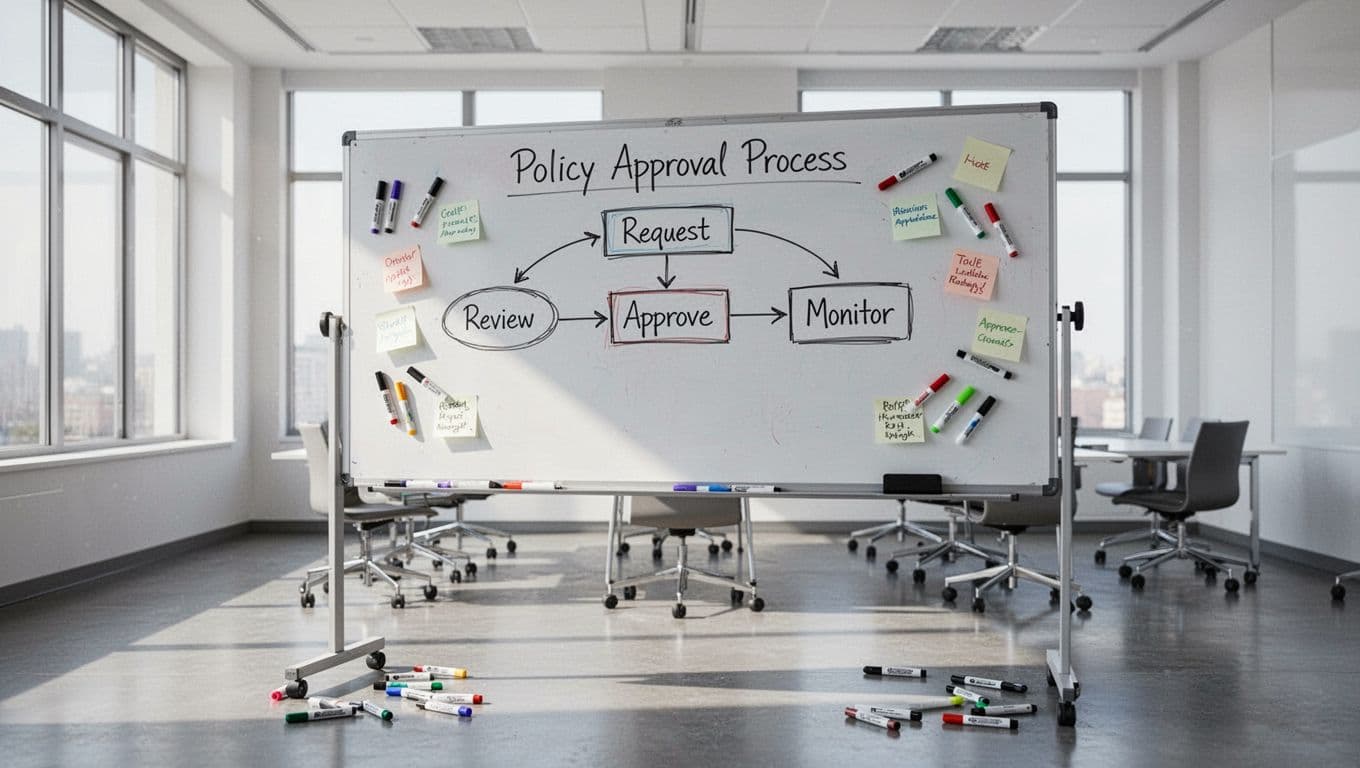
Next, create three tiers: approved, conditional, and banned. Tools like copilot that provide enterprise-grade security can fall into approved, for instance. Then set a simple request path for new tools, including copilot if customized. Most teams only need four steps: request, review, approve, and monitor (with ai detection software to check compliance).
Training also matters to build ai literacy. Managers should know when AI help is fine and when it crosses into high-risk use. In practice, short examples work better than long lectures. Show a safe prompt, an unsafe prompt, and a borderline case.
Finally, review the policy often. Quarterly works well in the first year. Many companies now map this process to NIST AI RMF or ISO/IEC 42001, because those frameworks help teams keep records, improve over time, achieve regulatory compliance, and mitigate risks.
Frequently Asked Questions
What is BYOAI?
BYOAI refers to employees using their own AI accounts, subscriptions, or browser tools for work tasks. It highlights the gap where productivity tools like personal ChatGPT or Copilot run without IT oversight, exposing companies to data risks. A policy channels this into approved, secure uses.
Why is a BYOAI policy urgent in 2026?
With 78% of knowledge workers using unapproved AI and data leakage up 156%, silence equals risk—especially as the EU AI Act tightens in August 2026. Most companies (82%) lack rules despite heavy use, making policies essential to prevent breaches and ensure compliance. It turns shadow AI into governed productivity.
What are the core elements of an effective BYOAI policy?
Key must-haves include tool approval lists, bans on confidential data in public AI, human review of all outputs, no AI-only high-risk decisions (e.g., hiring, legal), and fast incident reporting. The article’s table and template cover these with clear owners like IT, HR, and employees. This keeps policies short yet comprehensive for security and audits.
How do you roll out a BYOAI policy without blocking work?
Start with discovery of current tools/data use, create approved/conditional/banned tiers, set a simple four-step approval process (request-review-approve-monitor), and deliver short training with prompt examples. Map to NIST or ISO frameworks for ongoing reviews. Quarterly check-ins in year one help refine without stifling innovation.
What happens without a BYOAI policy?
Shadow AI continues unchecked, amplifying data exposure, compliance violations, and incidents in high-risk areas like HR or legal. Employees won’t wait, writing your risk profile via unmonitored tools. A first-draft policy with guardrails now prevents costlier fixes later.
Write the policy before shadow AI writes your risk profile
Employees won’t wait for a perfect memo. They’ll use shadow AI, the tool that helps them finish today’s work.
That is why a first draft matters more than a long debate. Put guardrails around data, decisions, and review now to prevent security breaches stemming from unmonitored generative AI use, then tighten the policy as your company learns.
Take this template, customize the brackets, and get it in front of HR, IT, privacy, and legal this week before sensitive information is at stake.