
AI Model Validation Checklist for Internal Teams in 2026
Most teams don’t release weak AI because they skipped testing. They release it because nobody set a hard standard for what passes, what fails, and who can stop the launch.
In 2026, AI model validation is a control function, not a side task for data science. You need evidence that can stand up to audit, incident review, and business scrutiny, whether you’re shipping a credit model, a claims classifier, a support copilot, or an agent that can take action in a live system.
That means building a checklist with owners, proof, approval rules, and monitoring hooks before anything reaches production.
What changed for validation in 2026
The biggest change is simple: policy language no longer counts as proof. Internal audit, regulators, and risk teams want to see test results, version histories, issue logs, and sign-offs tied to a real use case.
That pressure comes from several directions. The EU AI Act moved from planning to enforcement, with high-risk obligations applying in August 2026 and general-purpose AI model enforcement also taking effect in 2026. The European Commission’s guidelines for providers of general-purpose AI models make clear that documentation, evaluation, and ongoing updates aren’t optional paperwork. They are part of the operating burden.
In the US, state rules now matter more, especially for systems used in employment, lending, housing, and consumer-facing decision support. Financial firms also got revised interagency model risk guidance in April 2026. Even though that update carved generative and agentic AI out of model-specific rules, it still expects firms to validate design, use, and outcomes under general governance controls.
So the job of validation has widened. It’s no longer enough to ask whether a model performs well on a holdout set. You also need to know whether the data was appropriate, whether the system behaves safely under stress, whether subgroup harms are understood, and whether the team can detect drift after release.
A practical way to anchor this work is to map the process to the NIST AI RMF structure for validation and testing. It gives internal teams a common language for governance, risk mapping, measurement, and control.
Build a validation team with clear release authority
Validation fails when it is everyone’s job and nobody’s decision. You need named owners, and one of them must have authority to block release.
Independence matters here. In a small company, that might mean a model risk lead outside the build team. In a large enterprise, it may be a formal second-line validation function. Either way, the validator can’t be grading their own work without challenge.
This simple ownership map works well for most internal teams:
| Validation area | Primary owner | Required evidence | Release gate |
|---|---|---|---|
| Use case and risk tier | Product owner with risk lead | Intended use, impact rating, misuse scenarios | Risk classification approved |
| Data suitability | Data science lead with data governance | Lineage, sampling logic, rights, quality checks | No unresolved critical data issue |
| Technical performance | Independent validator | Frozen test results, baseline comparison, error analysis | Thresholds met on approved metrics |
| Safety, fairness, and security | AI safety, compliance, and security leads | Bias tests, abuse tests, prompt injection results, control coverage | High-severity findings closed or accepted |
| Operations and monitoring | MLOps owner with business owner | Logging, alerts, rollback plan, support runbook | Monitoring live before launch |
After the table is in place, require one approval memo. Keep it short. State the model version, deployment scope, open issues, compensating controls, and expiration date of the approval. A release decision with no expiry often turns into permanent permission.
If the validator can’t stop deployment, validation is advice, not control.
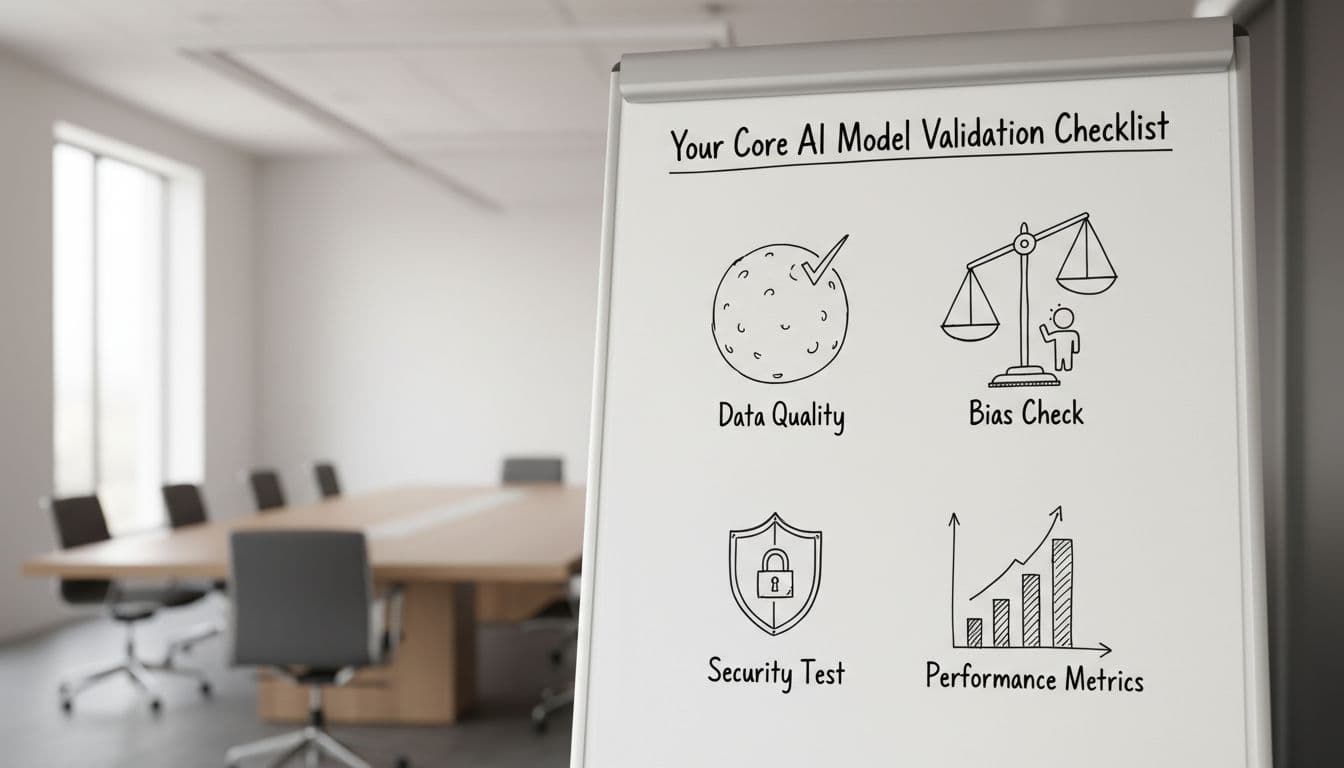
The pre-deployment checklist that should block weak models
Before any model moves to production, the team should complete a small set of checks that create hard evidence, not vague comfort.
- Confirm the exact use case, user group, and risk tier.
Write down what the model is allowed to do, what it must never do, and what human oversight exists. A fraud flagger, a hiring screener, and a drafting assistant do not need the same evidence. Approval should stop if the team can’t define intended use, foreseeable misuse, and material harm. - Prove the training, validation, and test data are fit for purpose.
The evidence should include lineage, collection dates, population coverage, known exclusions, label quality, and legal rights to use the data. For systems subject to EU rules, the technical documentation expectations in Article 53 and Annex XI make this level of detail hard to avoid. Release should stop if the team can’t explain provenance, curation, or material gaps. - Check split integrity and leakage risk.
This sounds basic, yet many failed validations start here. Make sure duplicates, time leakage, target leakage, and proxy leakage are tested, then documented. If the model learned future information or a label shortcut, the accuracy figure is fiction. - Validate against a real baseline, not a vanity benchmark.
The benchmark should reflect the business decision you are replacing or assisting. Compare against the current rules engine, the manual process, or the last approved model. Approval should require a measurable gain on agreed metrics, plus a review of where the model performs worse. - Test errors by segment, not only in the aggregate.
Run subgroup analysis for population slices that matter to the use case, such as region, language, channel, product type, or legally protected categories where permitted. If a model passes overall but fails badly for a smaller group, the business and compliance risk may still be unacceptable. Teams should record any residual disparity and who accepted it. - Run adversarial, abuse, and security testing.
For traditional ML, that can include malformed inputs, missing fields, out-of-range values, and extraction risk. For LLM systems, add prompt injection, jailbreak attempts, data exfiltration paths, unsafe completion tests, and tool misuse. A useful reference is this enterprise guide to LLM guardrail implementation, which treats failed adversarial cases as blocking defects in CI/CD. - Verify explainability, fallback behavior, and human override.
Your validator should be able to answer why the model made a decision, at least at the level required by the business and applicable law. Also check what happens when confidence drops, retrieval fails, a tool call errors, or the system hits a policy boundary. Release should stop if the fallback path is unclear or if humans can’t override bad outcomes. - Freeze documentation before approval.
The final packet should include the model card, validation report, test datasets or references, open issue register, monitoring plan, rollback plan, and change log. This step matters because a clean result with weak documentation still creates audit risk. Teams often treat documentation as admin work, then discover later that nobody can reconstruct what was approved.
A short example helps. If you’re validating a claims triage model, don’t stop at AUROC. Check false negatives on severe cases, subgroup differences across claim types, explanation quality for adjusters, and whether the escalation path works when the model confidence drops below threshold.
Extra checks for LLMs, RAG, and agents
Generative systems need a second layer of validation because the failure modes are wider. The model may be fluent, quick, and still wrong in ways that ordinary ML tests won’t catch.
For a chatbot or copilot, test groundedness, refusal behavior, sensitive data handling, and output stability. If the system cites retrieved documents, verify that citations point to real sources and support the answer. A RAG workflow should also be scored for retrieval quality, because poor retrieval can look like model hallucination when the root cause is missing context.
Agentic systems add more risk. Once a model can call tools, write to systems, or trigger workflows, you need action-level controls. The Agentic Reliability Checklist is useful because it treats tool safety, resource governance, data integrity, and human interaction as separate test domains. That’s closer to how agents fail in practice.
Human review still matters. LLM-as-a-judge can help sort large output sets, but internal teams should spot-check by trained reviewers and calibrate judge prompts against human labels. If the model writes customer emails, ask reviewers to score factual accuracy, policy compliance, harmful content, tone, and actionability, then measure agreement rates.
If your eval set contains only happy-path prompts, you haven’t validated a generative system.
For many teams, the simplest rule is this: every high-impact LLM workflow needs a red-team set, a regression set, and a production-like test set before release. Anything less leaves large blind spots.
Metrics that matter more than headline accuracy
A single performance number rarely tells you whether a model is safe to ship. Internal teams need metrics that line up with harm, cost, and user experience.

For traditional ML, use decision-aware measures. In fraud detection, false negatives may matter more than overall accuracy. In ranking, calibration and lift may matter more than AUC alone. In forecasting, bias and error spread often matter more than mean error by itself.
For generative systems, use a mix of task and operational metrics. Teams often track factual accuracy, groundedness, safety violation rate, refusal correctness, latency, token cost, and fallback frequency. The continuous AI evaluation approach described by Swept AI gets this right: pre-launch testing is necessary, but production evaluation is where failure patterns show up.
Set pass thresholds in advance. Also define what counts as a blocking defect, a waiver, or a monitored risk. If a support copilot exceeds the hallucination cap but only on low-volume intents, you may allow a limited rollout with stricter human review. If the same pattern appears in medical guidance or lending support, it should block release.
Use two baselines. Keep one frozen benchmark for trend analysis and one live benchmark that reflects current production traffic. That split helps teams catch both regression and drift.
Deployment gates and ongoing monitoring after go-live
Production is where AI model validation either proves its value or gets exposed as paperwork. Teams need change control, live telemetry, and a clear revalidation policy.
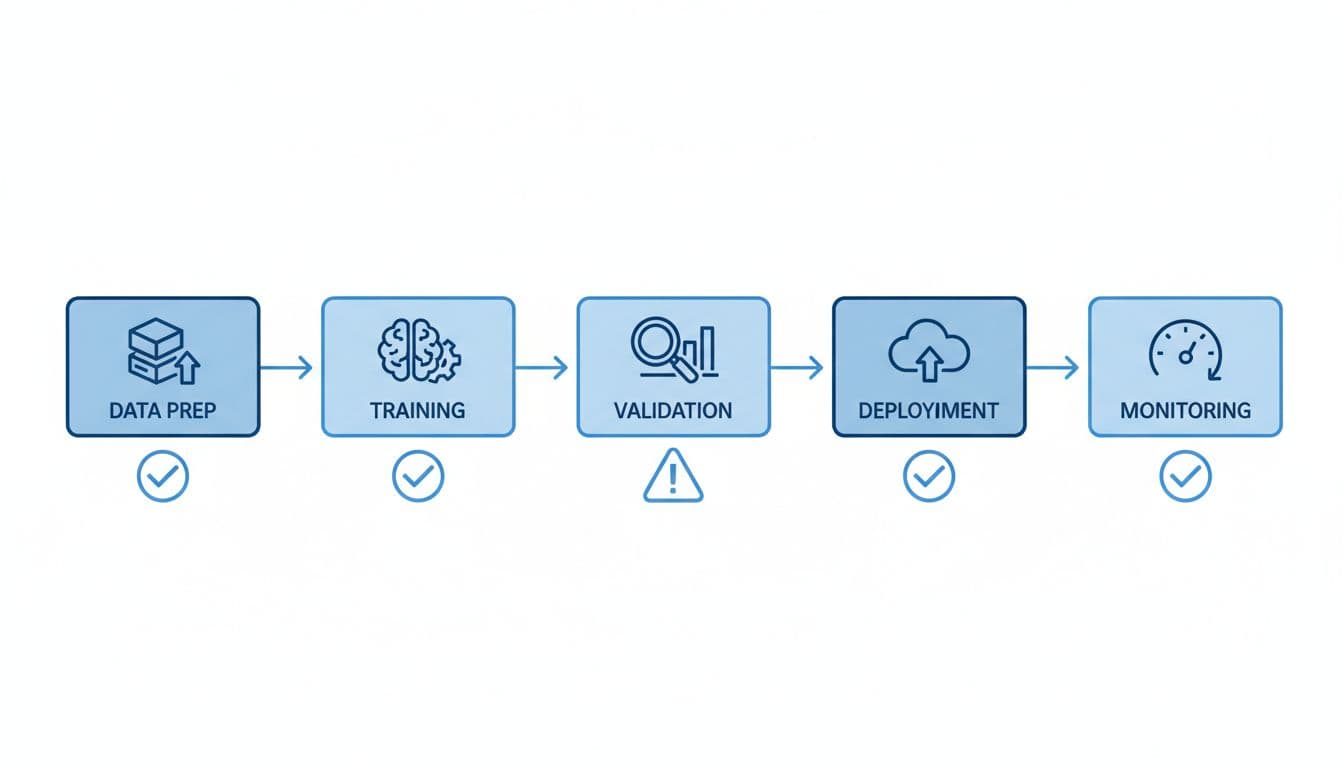
Start with a deployment gate tied to exact versions. That includes model version, prompt version, retrieval index version, policy rules, dependency versions, and vendor endpoint details. If any of those change, the system is no longer the one you validated.
This matters more in 2026 because vendors update foundation models often, sometimes with limited notice. Internal teams should classify changes into minor, material, and critical. A prompt wording tweak may need regression testing. A base model change or retrieval pipeline change may require partial or full revalidation.
Monitoring should watch technical quality and business impact. That means outcome rates, subgroup shifts, unsafe output rates, fallback rates, latency, cost, complaint volume, and manual override rates. For regulated or high-risk use cases, the EU AI Act conformity assessment view points in the same direction: testing is not a one-time event, and post-market monitoring has to be real.
Set alerts for a small number of triggers that force human review:
- Material drop in approved performance metrics
- Subgroup disparity above the accepted limit
- Prompt injection, data leak, or policy-violation spikes
- Unapproved vendor, model, prompt, or retrieval changes
Also watch for shadow AI. In many firms, employees now use unapproved copilots or APIs outside the governed stack. If those outputs enter decisions, your formal validation process can be bypassed without anyone noticing.
A good monitoring plan names the owner of each alert, response times, rollback conditions, and revalidation frequency. Quarterly is common for low-risk systems. High-impact models may need monthly reviews or event-driven revalidation after incidents and major changes.
Common failure points inside internal validation
The most common failure is borrowed evidence. Teams use vendor benchmarks, public leaderboards, or sandbox demos as if they prove production fitness. They don’t. External evidence can support a case, but it can’t replace internal testing on your data, users, and workflows.
Another failure point is weak documentation discipline. Teams run strong tests, then fail to freeze datasets, prompts, thresholds, or issue logs. Six months later, nobody can tell what was approved. The Complete AI Audit Checklist for 2026 is a good reminder that audit readiness starts with traceability, not style.
The third pattern is dead monitoring. Alerts fire, nobody owns them, and the model keeps running. Or worse, teams collect dashboards that can’t trigger action. Monitoring only works when the business agrees in advance what happens after a threshold breach.
Last, many groups still validate only the model and ignore the system around it. In 2026, that’s too narrow. Retrieval layers, prompts, tool permissions, human review steps, and vendor changes all affect outcomes. Validate the full workflow, or expect gaps.
Conclusion
Strong validation in 2026 is built on three things: clear ownership, hard evidence, and release gates that can block bad decisions. The technical work still matters, but it has to connect to governance, operations, and monitoring.
If your team can’t produce a current validation packet, explain who accepted residual risk, and show what will trigger revalidation, the model is not production-ready. AI model validation works when it is treated as an operating control, not a final presentation before launch.