
A Practical AI Business Case Template for Internal Teams in 2026
Most AI projects don’t fail in the pilot. They fail in the funding memo.
Internal teams often have interest, a vendor demo, and a rough savings estimate. What they need is an approval-ready case that finance, security, IT, operations, and business leaders can all support.
A good AI business case template turns a promising use case into a decision with clear scope, cost, controls, and outcomes. In 2026, that bar is higher, so the case has to be tighter.
What an internal AI business case must prove now
A weak business case talks about AI features. A strong one proves that a business problem is real, measurable, and worth solving with AI instead of simpler automation.
That matters because most leadership teams have moved past “we should do something with AI.” They want to know where value will show up, how risk will stay within policy, and who owns the result after launch. The best cases also move beyond simple ROI and show operational fit.
In 2026, build versus buy belongs near the front of the document, not buried in an appendix. Current market reporting puts roughly 76 to 80 percent of enterprise AI use cases in the buy category. That lines up with how most teams work today. Buying usually means faster rollout and lower upfront spend. Building can still make sense, but only when the workflow is unique, the data is a true asset, and the team can support long-term maintenance.
Cost assumptions need the same honesty. Custom builds often start around $100,000 to $500,000 before ongoing cloud, evaluation, and staffing costs. Bought tools shift more spend into annual software and support, often with faster time to value. Either way, your model should include integration work, security review, human QA, and adoption support.
Governance also has to sit inside the case. Security and compliance teams will ask about data class, access controls, prompt injection risk, logging, retention, human review, and incident response. A practical AI governance framework template can help teams set those controls early, while current thinking on enterprise AI governance and security shows why this is now an operating issue, not a side task.
If you can’t name the owner, data source, and success metric, the use case isn’t ready for funding.
The AI business case template your team can fill in
Use one document for both approval and delivery. That way, the case doesn’t stop being useful once the budget clears.

This simple structure works well for internal teams:
| Section | What to include | Question to answer |
|---|---|---|
| Executive summary | The ask, sponsor, budget, timeline, expected outcome | What decision do we need now? |
| Problem and workflow | Current pain point, volumes, baseline cost or time, users | Which step is broken today? |
| Proposed AI solution | Use case, model type, human review, systems touched | Where will AI act, and where won’t it? |
| Options and build vs buy | Buy, build, and hybrid paths, with recommendation | Is this a standard need or a custom edge? |
| Data and integration readiness | Source systems, quality, permissions, gaps, dependencies | Is the data usable, lawful, and available? |
| Financial case | Setup costs, run costs, savings, revenue impact, payback | Which assumptions drive value? |
| Risk and governance | Privacy, security, bias, monitoring, owners, review gates | What could go wrong, and how do we control it? |
| Change plan and KPIs | Training, process updates, adoption targets, success metrics | How will behavior change after rollout? |
Each section should have a named owner and evidence. Don’t accept vague text like “data is available” or “security review later.” Instead, ask for the source system, data steward, integration dependency, approval path, and date.
The financial section deserves extra care because AI costs are often usage-based. Include licenses or API fees, testing, red-teaming, observability, retraining or prompt updates, and vendor support. If you’re buying, compare at least two vendors. If you’re building, show why the extra control or IP matters enough to justify the cost and delay.
For reference, this board-ready AI business case template is a useful starting point. Internal teams usually need one more layer of detail so delivery, governance, and finance can work from the same file.
Sample AI business case outline teams can adapt
Below is a simple outline that works well in a six- to ten-page memo or a short slide deck.
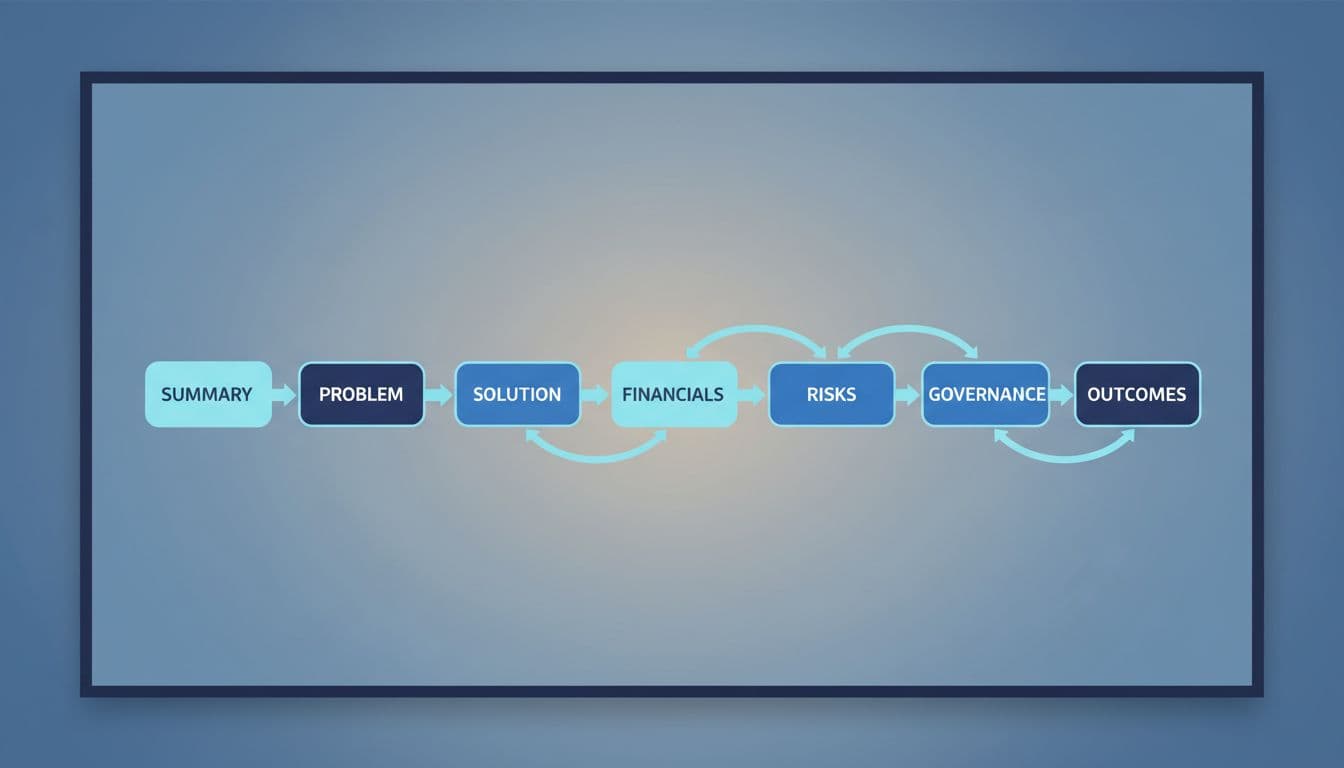
- The executive summary states the decision, sponsor, budget range, timeline, and expected business outcome in one paragraph.
- The problem section names the workflow, current SLA, monthly volume, failure rate, labor hours, and business impact.
- The solution section explains what AI will do, what people will still do, and where the model connects to current systems.
- The options section compares buy, build, and hybrid paths with expected cost, speed, and control.
- The data section lists source systems, data quality issues, retention rules, access controls, and needed cleanup work.
- The business case section shows baseline metrics, expected lift, full cost model, payback period, and go or no-go thresholds.
- The risk section records privacy, security, bias, legal, model drift, and vendor risks, plus the control for each one.
- The rollout section names pilot scope, training needs, owners, review dates, and the KPI dashboard.
A short example makes this real. Suppose an operations team wants AI support for invoice exception handling. The case should say how many exceptions arrive each month, current cycle time, rework rate, and staff hours. Then it should define the target, such as reducing manual review time by 30 percent while keeping accuracy above 98 percent. It should also state whether the team will buy a document AI product, add custom rules, or build around a foundation model.
Finally, add stage gates. For example, approve discovery only if the workflow owner signs, the data steward confirms access, and security classifies the data. Approve pilot only if baseline metrics are trusted and human review is built in. That keeps the case grounded in delivery, not wishful thinking.
A good AI business case template doesn’t sell AI. It helps the business make a clear, bounded choice.
When the case names the workflow, costs, controls, adoption plan, and owner, approval gets easier. More importantly, the project has a much better shot at producing real business results instead of another stalled pilot.